



Most people assume better workouts require a bigger life.
More time. More equipment. More motivation. A stricter schedule. A better gym. A new program. A new version of yourself who wakes up early, drinks enough water, stretches daily, eats perfectly, and never loses interest.
But the truth is less dramatic and more useful: many workouts do not need to become harder. They need to become clearer.
A more effective workout is not always longer or more intense. It is often a workout done with better preparation, better form, better pacing, and a better understanding of what you are trying to improve. Small changes, repeated consistently, can make ordinary training much more productive.
The Centers for Disease Control and Prevention recommends that adults get at least 150 minutes of moderate-intensity aerobic activity each week and do muscle-strengthening activities at least two days a week, working all major muscle groups. The same guidance notes that activity can be spread throughout the week and broken into smaller chunks, which is good news for people who are not living inside a fitness commercial.
Here are 10 small changes that can make your workouts more effective without making your life revolve around exercise.
1. Decide the Purpose Before You Start
A workout without a purpose can still be good for you. Movement counts. Sweat counts. A walk, a class, a lift, a bike ride — all of it can matter.
But if you want better results, your workout should have a job.
Are you trying to build strength? Improve endurance? Practice technique? Burn off stress? Recover from a harder training day? Maintain consistency during a busy week?
Each purpose asks for a different kind of effort.
A strength workout should not feel like a frantic cardio circuit. A recovery session should not become a secret competition. A run meant to build endurance should not turn into an ego-driven sprint because someone passed you on the sidewalk.
Before you begin, name the purpose in one sentence.
“Today I am training legs with control.”
“Today I am walking briskly for 30 minutes.”
“Today I am practicing good form, not chasing exhaustion.”
“Today I am doing the minimum because the day is crowded, and that still counts.”
This simple habit keeps you from drifting. It also helps you judge the workout fairly. Not every session needs to leave you breathless. Not every session needs a personal record. Sometimes the most effective workout is the one that does exactly what it was supposed to do.
Clarity is underrated. It turns exercise from random effort into training.
2. Warm Up for the Workout You Are Actually Doing
A warm-up should not be a vague ritual you rush through because you know you are supposed to.
It should prepare your body for the specific work ahead.
If you are going to squat, warm up your hips, ankles, legs, and core. If you are going to press, prepare your shoulders, upper back, and chest. If you are going to run, start with walking or easy jogging before increasing speed. If you are doing a full-body session, use movements that gradually raise your heart rate and rehearse the patterns you will train.
Mayo Clinic notes that warming up correctly may help reduce injury risk and improve athletic performance, and its weight-training guidance recommends 5 to 10 minutes of brisk walking or another aerobic activity before lifting.
The point is not to spend half the workout warming up. The point is to stop asking cold muscles and stiff joints to perform at full speed.
A useful warm-up can be simple:
Walk or cycle for five minutes.
Do bodyweight squats before weighted squats.
Do light rows before heavy rows.
Do easy push-ups or band pull-aparts before pressing.
Do a few lighter sets before your working weight.
A good warm-up also gives you information. Maybe your hip feels tight. Maybe your shoulder needs more time. Maybe the weight you planned feels heavier than expected. That does not mean the workout is ruined. It means you are paying attention early enough to adjust.
Training well begins before the hard part starts.
3. Slow Down the Reps
Many people move too quickly when they exercise.
They drop into squats. Bounce through push-ups. Swing dumbbells. Rush lunges. Let gravity handle the lowering phase. The workout feels intense, but intensity is not always the same as quality.
Slowing down can make the same exercise more effective.
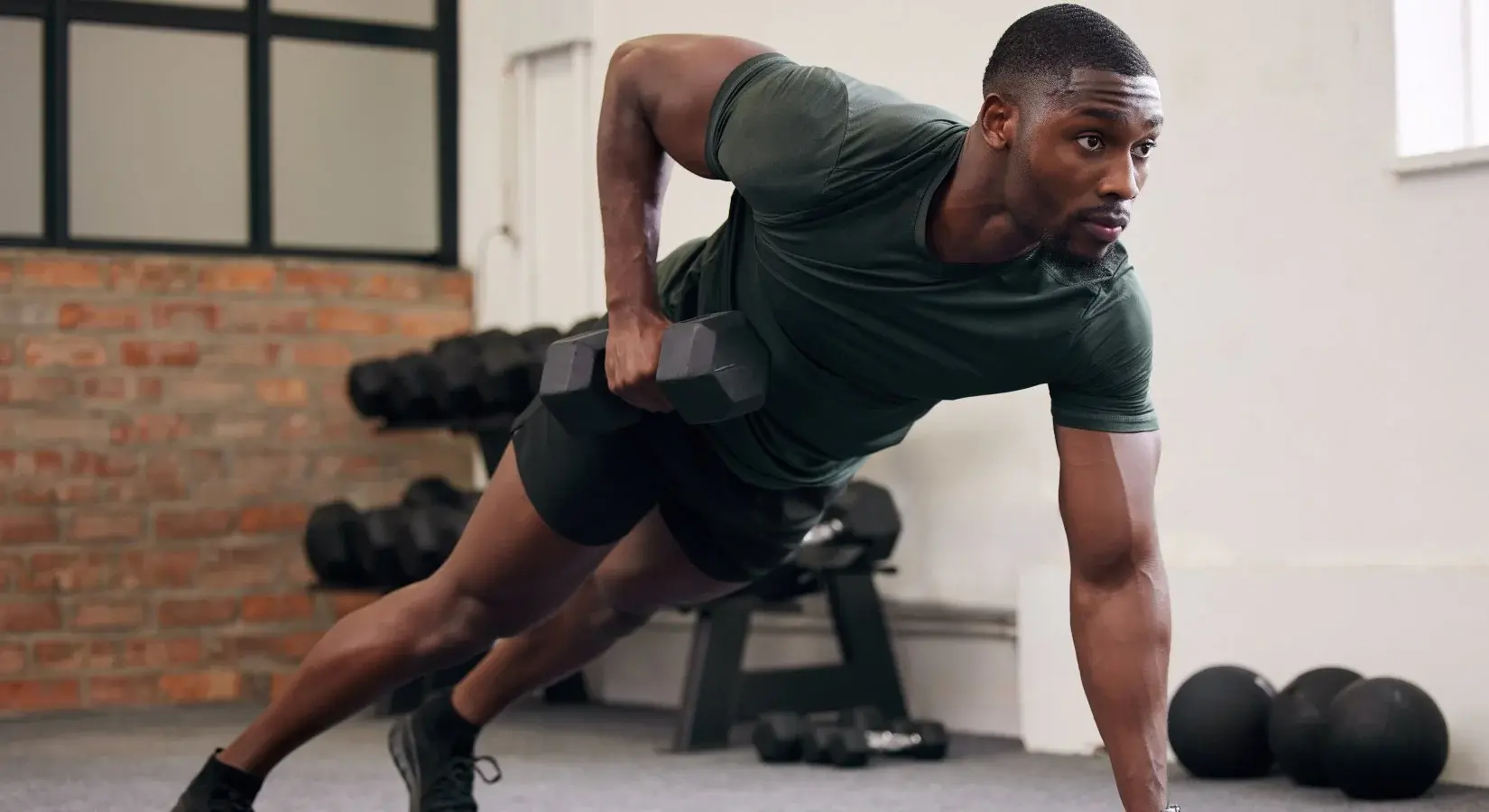
When you lower a weight with control, you increase time under tension. You also give yourself a chance to notice form. Are your knees tracking well? Is your back staying neutral? Are your shoulders stable? Are you using the muscle you meant to train, or just momentum?
This does not mean every repetition needs to be painfully slow. But control should be visible.
Try this: lower for two or three seconds, pause briefly, then lift with purpose. Do this with squats, push-ups, rows, Romanian deadlifts, or presses. You may need to use less weight. That is not failure. That is honesty.
Mayo Clinic’s strength-training guidance specifically advises moving weights in a controlled way and not rushing.
There is a reason controlled movement feels harder: your muscles are doing more of the work. That is the point.
A sloppy set may look impressive from across the room. A controlled set is often the one that builds the body you actually want.
4. Track One or Two Things, Not Everything
You do not need to turn your life into a spreadsheet to make progress.
But you should track something.
A workout log gives you evidence. Without it, you are guessing. You may think you are training hard, but never increasing the challenge. You may think you are stuck, but the numbers may show that you are lifting more, walking faster, or recovering better than you were a month ago.
Keep it simple.
Write down the exercises, weights, reps, sets, distance, time, or how the workout felt. For strength training, track the main lifts. For walking or running, track time and pace. For mobility, track consistency. For general fitness, track how many workouts you complete each week.
Do not track so much that the habit becomes exhausting. The goal is awareness, not surveillance.
Progress often looks small in the moment. One extra rep. Five more pounds. A slightly faster mile. A longer plank. A workout completed on a day when you almost skipped it.
These small wins are easy to miss if you do not record them.
Tracking also helps you avoid the common mistake of changing programs too quickly. If you never stay with a plan long enough to measure progress, every new routine feels exciting and none of them teach you much.
A notebook, app, or note on your phone is enough.
What gets measured does not always improve automatically. But what gets noticed has a much better chance.
5. Add Challenge Gradually
Your body adapts when it is challenged. But it adapts best when the challenge is progressive, not chaotic.
This is the principle behind progressive overload: over time, you gradually increase the demand placed on the body. The American College of Sports Medicine describes progressive resistance training as necessary for continued adaptation toward specific training goals.
The word that matters is gradually.
You can make a workout harder by adding weight, doing more reps, adding another set, improving range of motion, slowing the tempo, reducing rest slightly, or choosing a more difficult variation. You do not need to change all of those at once.
In fact, you probably should not.
If you add weight, reps, sets, and intensity in the same week, you may not be training smarter. You may simply be collecting fatigue.
A better method is to adjust one variable at a time. If you can do three sets of 10 goblet squats with good form, try three sets of 11 next time. Or use a slightly heavier weight and stay at 10. If your brisk walk feels easy, add five minutes or choose a hill. If your push-ups are improving, lower the incline rather than doubling the volume.
Progress should feel like a dial, not a switch.
The best training plans make the body say, “I can adapt to this,” not, “What just happened?”
6. Rest Enough Between Hard Sets
Rest is not wasted time. It is part of the work.
In many gyms and home workouts, people move quickly from one exercise to the next because they believe constant motion means a better session. Sometimes that is true, especially for conditioning. But if your goal is strength or muscle growth, resting too little can reduce the quality of your sets.
A heavy squat, row, press, deadlift, or lunge requires focus and force. If you start the next set while you are still gasping, your muscles may not be the limiting factor. Your conditioning may be. Your form may break down. You may use less weight than you could have handled with adequate rest.
This does not mean sitting around for 10 minutes between every set. It means matching your rest to the goal.
For heavier strength work, one to three minutes may be useful. For smaller accessory exercises, shorter rest can work well. For circuits, the rest may be built into the structure.
The key question is: Can you perform the next set well?
If the answer is no, rest a little longer.
There is a quiet discipline in waiting. It can feel less exciting than constant movement, but it often produces better training. You are not trying to look busy. You are trying to create enough quality effort for the body to adapt.
The workout is not more effective because you were out of breath the entire time.
It is more effective when the hard sets are actually good.
7. Stop Skipping the Basic Movements
Fitness culture loves novelty. New exercises get attention. Complicated routines look impressive. Strange variations seem more advanced than the movements everyone already knows.
But most effective training still depends on basic patterns.
Squat. Hinge. Push. Pull. Carry. Brace. Walk. Climb. Rotate with control.
These movements train the body in ways that matter beyond the gym. They help you pick things up, carry groceries, climb stairs, stand taller, move better, and build strength that is useful in daily life.
The CDC’s adult activity guidance recommends muscle-strengthening activities that work all major muscle groups, including the legs, hips, back, abdomen, chest, shoulders, and arms.
You do not need to do the most advanced version of each movement. A squat can be a bodyweight squat, goblet squat, split squat, or leg press. A hinge can be a hip thrust, Romanian deadlift, or kettlebell deadlift. A push can be a push-up, dumbbell press, or machine press. A pull can be a row or pulldown.
The exercise should fit your body, experience, and equipment.
But the pattern should appear somewhere.
A workout full of random movements may make you tired. A workout built around basic patterns makes you better.
8. Make the Last Reps Honest, Not Ugly
The last few reps of a set tell you a lot.
They show whether the weight is appropriate. They show whether your form holds under fatigue. They show whether you are challenging yourself or simply going through the motions.
But there is a line between hard reps and ugly reps.
Hard reps are slower. They require focus. They make you breathe. They ask for effort. But the movement still looks like the exercise you intended to perform.
Ugly reps are different. Your back rounds. Your knees collapse. Your shoulders shrug. Your body twists. You bounce, swing, or yank. The target muscle is no longer the main worker. The rep becomes a negotiation between ego and gravity.
Most people do not need to take every set to failure. In many cases, leaving one or two good reps in reserve is enough to build strength and muscle while keeping form intact. This is especially useful for beginners and intermediate exercisers.
A set should usually end because you have reached the edge of quality, not because the exercise has fallen apart.
That does not mean avoiding effort. It means respecting the purpose of effort.
The body adapts to what you repeat. If you repeatedly practice messy movement under fatigue, you get better at messy movement under fatigue. That is not the goal.
Train hard enough to grow.
Stop early enough to return.
9. Treat Recovery as Part of the Workout
Recovery is not what happens when training stops. It is what makes training work.
A workout creates stress. The body responds afterward. Muscle repair, energy restoration, nervous system recovery, and adaptation all require time and resources. If you train hard but sleep poorly, under-eat, skip rest days, and ignore pain, progress eventually suffers.
Recovery does not need to be complicated. Start with the basics: sleep, food, hydration, rest, and easy movement.
Eat enough to support your training. Include protein regularly. Do not fear carbohydrates if you train with intensity; they help fuel many forms of exercise. Drink water. Take rest days. Walk or stretch lightly when you feel stiff. Protect sleep as much as your life allows.
The CDC emphasizes that some physical activity is better than none and encourages adults to move more and sit less, while also recommending both aerobic and muscle-strengthening work. That broad approach matters: effective fitness is not just one hard hour in the gym, but the pattern of movement, recovery, and consistency around it.
Recovery also means listening to pain.
Sore muscles are common. Sharp pain, joint pain, pain that changes your form, or pain that worsens as you continue should not be ignored. Modify the movement. Reduce the load. Stop if needed. Seek help from a qualified professional if pain persists.
You do not get extra credit for turning a small problem into a long injury.
The goal is not to train as much as possible.
The goal is to train in a way you can keep adapting to.
10. Have a Short Backup Workout Ready
The perfect workout is fragile.
It depends on time, energy, equipment, sleep, schedule, and mood. Real life does not always cooperate.
That is why every person who wants to stay consistent should have a backup workout. Not a second-best workout that makes you feel guilty. A real workout designed for busy days.
It might be 10 minutes:
10 squats
8 push-ups
10 reverse lunges per side
20 seconds of plank
Repeat three times
Or 15 minutes:
Goblet squats
Dumbbell rows
Romanian deadlifts
Floor presses
Two or three rounds
Or a brisk 20-minute walk.
The backup workout protects the habit. It keeps one difficult day from becoming a lost week. It teaches you that fitness is not all-or-nothing.
This matters more than people think.
Many routines fail not because the workouts are bad, but because the plan has no answer for imperfect days. Once the full workout becomes impossible, the person does nothing. Then the next day feels harder. Then the routine starts to fade.
A short workout may not deliver everything a full session would. But it delivers something valuable: continuity.
Consistency is built by people who know how to adjust without quitting.
A Simple Way to Apply These Changes This Week
Do not try to fix everything at once.
Choose three changes for your next week of workouts.
Warm up properly.
Track your main exercises.
Slow down your reps.
Add one small progression.
Rest longer between hard sets.
Create a backup workout.
At the end of the week, ask what improved. Did your form feel better? Did you feel more focused? Did you recover more easily? Did you complete more workouts because the plan was realistic?
The best changes are the ones you can repeat without needing a burst of motivation.
That is how effective training is built: not through constant reinvention, but through small improvements that make the same work more useful.
A Note on Safety and Trust
Exercise advice should never pretend that every body needs the same plan.
Age, injury history, training experience, medical conditions, pregnancy, medications, stress, sleep, and personal goals all matter. If you have chest pain, unexplained dizziness, persistent joint pain, recent surgery, or a medical condition that affects exercise, speak with a qualified health professional before starting or changing your routine.
Good training should challenge you. It should not make you feel unsafe.
The most trustworthy fitness plan is not the one that promises the fastest transformation. It is the one that helps you build capacity while respecting the body you have today.
The Bottom Line
You do not always need a new workout.
Sometimes you need a better version of the workout you are already doing.
Decide the purpose. Warm up with intention. Slow down. Track a few key details. Progress gradually. Rest enough. Use basic movements. Keep the last reps honest. Recover seriously. Have a backup plan.
None of these changes is dramatic. That is why they are easy to underestimate.
But fitness is rarely changed by one dramatic moment. It is changed by the quiet accumulation of better choices.
A little more control. A little more consistency. A little more attention.
That is where ordinary workouts become effective ones.
Important notice: this content is educational and does not replace an individual evaluation. If you have a history of eating disorders, diabetes, pregnancy, or a medical condition, consult a healthcare professional before making dietary or exercise changes.









 Sign In