

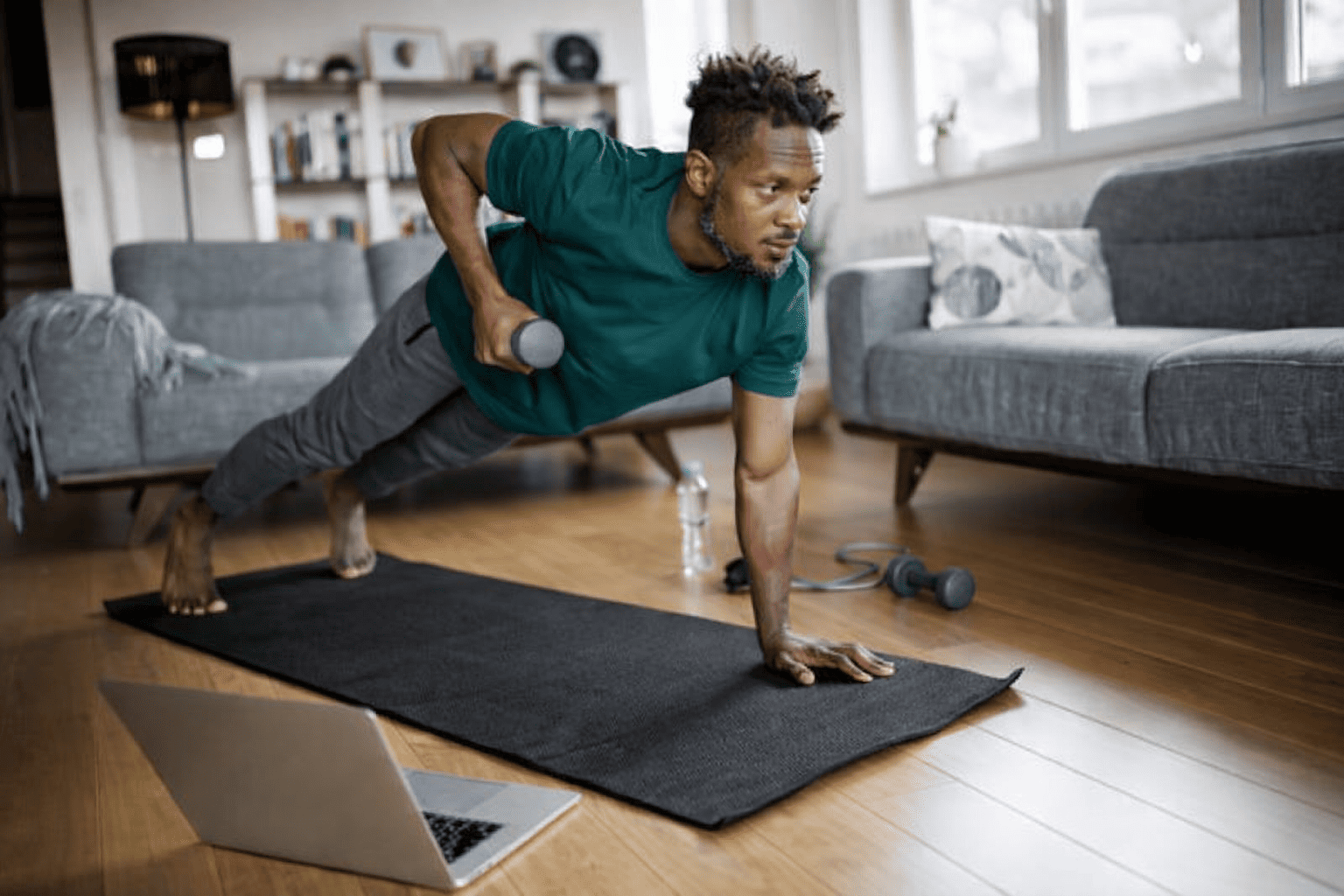

There is a small industry built on the idea that a serious workout requires a serious purchase. A rack. A rower. Adjustable dumbbells with the price tag of a month’s rent. A mat made from some patented compound that promises to improve discipline by osmosis. The message is subtle but persistent: if your home gym is modest, your effort must be modest too.
It is a convenient myth, and for many people, a paralyzing one.
The truth is less glamorous and more useful. Challenge in fitness rarely comes from price. It comes from leverage, stability, tempo, range of motion, work-to-rest balance and consistency. A staircase can humble you. A backpack can become heavy. A slow set of split squats can feel longer than a room full of machines. And research increasingly supports the common-sense point that home-based training can produce real results. Adults are still advised to get at least 150 minutes of moderate aerobic activity per week, with muscle-strengthening work on two or more days; for additional health benefits, that aerobic target can rise to 300 minutes a week. Just as important, some activity is better than none, and it can be accumulated in smaller pieces.
That matters because the biggest obstacle for many people is not a lack of knowledge. It is a lack of frictionless access. If exercise requires a commute, a queue for equipment, and a perfect hour in the calendar, it begins to look less like a habit and more like an event. Home training changes that equation. A 2023 systematic review and meta-analysis found that home-based HIIT improved cardiorespiratory fitness compared with no exercise, and appeared comparable to lab-based HIIT and moderate-intensity continuous training in improving fitness. A smaller 2023 trial on video-directed whole-body HIIT performed at home found gains in VO2peak, leg lean mass, strength and muscle endurance after eight weeks. Home workouts are not a consolation prize. Done well, they are a legitimate training setting.
The mistake, then, is not training at home. The mistake is thinking home training must imitate a fully equipped gym to count. It does not. What it needs is enough structure to create effort, enough variety to stay engaging, and enough progression to keep the body adapting. These nine ideas do exactly that.
1. Slow-Tempo Bodyweight Strength Work
The fastest way to make a simple exercise harder is often to do it more slowly.
People tend to associate challenge with speed or chaos, but tempo is a more elegant tool. Lowering into a squat for four seconds, pausing for one, then rising under control can turn an ordinary movement into a demanding one without changing the equipment list at all. The same is true of push-ups, lunges, glute bridges and pike presses. Slowing the movement increases time under tension, sharpens technique and exposes shortcuts. You stop bouncing through the easiest version of the exercise and start actually doing it.
At home, that matters because tempo creates resistance where the room cannot. A bodyweight squat may not feel like much when you rush through 20 careless repetitions. It feels very different when you descend slowly, hold the bottom, and stand up without momentum. That difference is not imaginary. Progressive resistance training depends on manipulating variables such as load, repetition range, rest and movement control to keep adaptation going; challenge is not only about adding weight.
For beginners, a session can be surprisingly simple: three rounds of slow squats, incline or floor push-ups, reverse lunges and glute bridges. For more experienced exercisers, the same structure becomes harder by extending the lowering phase, reducing rest, or choosing more demanding variations. The appeal of tempo work is that it is honest. It does not let momentum do the job your muscles were supposed to do.
2. Staircase Intervals
Every building with stairs is, in a sense, hiding a piece of cardio equipment in plain sight.
Stair work is effective because it compresses effort. You are moving your body vertically, against gravity, in a pattern that quickly recruits the legs, elevates the heart rate and leaves very little room for coasting. A 2024 scoping review concluded that stair-climbing interventions show potential benefits for cardiometabolic outcomes in adults and emphasized the practicality and accessibility of stair climbing as a form of exercise. That last point matters as much as the physiology: accessible exercise gets used.
The beauty of stair intervals is that they can be scaled with uncommon precision. A beginner might walk up one flight at a steady pace, then recover by walking slowly back down and resting before repeating. Someone more conditioned can do multiple flights, increase the pace, or use work-rest intervals that feel more athletic. You can make it a 10-minute session, a 20-minute session, or a finisher after strength work. The format is flexible without becoming vague.
There is also something psychologically useful about stairs: they are almost impossible to romanticize. They demand effort, but not performance. Nobody needs a special outfit or a ring light to climb a staircase. And because the bouts are naturally short, they suit the modern attention span. A few hard climbs, repeated with intention, can make a small space feel like a training ground.
3. A Loaded Backpack Circuit
The backpack is perhaps the most democratic piece of home equipment ever invented.
Fill it with books, bottled water, bags of rice or whatever dense household objects you trust not to break your floor, and you suddenly have a variable load you can squat with, hinge with, carry, row and press. It is not elegant. That is part of its appeal. The backpack forces you to stop waiting for ideal conditions and start using the basic principle that matters most in strength training: progressive overload. If the body is asked to handle more challenge over time, it adapts.
A good backpack circuit might include squats, Romanian deadlifts, bent-over rows, front-loaded split squats and loaded carries around a hallway or living room. The point is not that a backpack perfectly mimics a barbell. It does not. The point is that it provides enough external resistance to move beyond the limits of pure bodyweight for many exercises, especially for the legs and back. For beginners and intermediate exercisers alike, that can make home training feel less like maintenance and more like actual strength work.
What makes this method especially effective is that it encourages full-body training. You do not need 12 exercises. You need a handful of movements that ask large regions of the body to work hard. The backpack excels there. It is crude, adjustable and, in the right workout, surprisingly unforgiving.
4. Resistance-Band Push-and-Pull Sessions
Resistance bands have long suffered from a credibility problem. People tend to see them as rehab tools, travel accessories or the thing you use when the “real” equipment is unavailable. The evidence is kinder than that reputation. A systematic review and meta-analysis found that training with elastic resistance produced strength gains similar to conventional resistance methods. Bands are not a toy. They are a cheap, portable way to create meaningful muscular tension.
That makes them especially useful at home, where one of the hardest things to replicate is upper-body pulling. Push-ups are easy enough to program. Rows are harder without gear. Bands solve some of that problem. Anchored rows, pulldown variations, chest presses, overhead presses, biceps curls, triceps extensions and face pulls can all be done with a small amount of space and a little setup. Suddenly the body is not just being trained in front-body patterns that are convenient on the floor; it is being worked more completely.
There is a second advantage, which is that bands travel well across skill levels. Beginners can use them for assistance and control. More advanced users can use them to add tension to already difficult moves or to accumulate volume without beating up their joints. They also work well in circuits, where the absence of plate changes or rack adjustments keeps the session moving.
Cheap equipment is not inherently virtuous. But cheap equipment that is genuinely useful is rare. Bands belong in that category. They remove one of the main excuses people make about training at home: that there is no practical way to challenge the upper body. There is.
5. EMOM Workouts That Keep You Honest
One of the easiest ways to make a home workout challenging is to stop letting yourself drift through it.
That is where EMOM training — every minute on the minute — becomes valuable. You pick a movement or short sequence, do the prescribed work at the top of each minute, then rest for the remainder before the next round starts. The format is simple enough to remember and strict enough to create urgency. It turns your living room into a place with a clock, which is often all a workout really needs.
EMOMs work particularly well at home because they solve a common problem: not the lack of exercises, but the lack of boundaries. Without a class, a coach or a crowded gym, many people underdose their effort. They scroll between sets, refill their water bottle twice, wander into the kitchen, and call it active living. An EMOM closes those escape routes. If you are doing 10 squats and 8 push-ups every minute for 12 minutes, the session acquires a shape. It becomes undeniable.
This style also fits neatly with what the evidence says about home-based interval training. Home HIIT has been shown to improve cardiorespiratory fitness and may be comparable to more formal lab-based or continuous training when programmed sensibly. The point is not that every home workout should feel maximal. It is that short, structured bouts of work can be very effective, especially when time is limited.
A well-designed EMOM does not need to be exotic. Squats, push-ups, mountain climbers, rows with a band, step-ups, dead bugs, burpees if you truly insist. The challenge comes from density: enough work, delivered on a clock, with little room for self-deception.
6. Single-Leg Training That Makes Light Loads Feel Heavy
When people say home training is not hard enough, what they often mean is that they have not yet discovered unilateral work.
Train one limb at a time and the arithmetic of effort changes immediately. Split squats, rear-foot-elevated split squats, single-leg Romanian deadlifts, step-ups and single-leg glute bridges all concentrate load and stability demands in a way that makes modest resistance feel substantial. Even bodyweight alone can be enough to turn a lower-body session into something memorable. That is because unilateral movements do not merely ask for force. They ask for balance, control and coordination too.
This is one of the most reliable ways to make home workouts feel athletic without making them complicated. A pair of light dumbbells, a backpack, or no equipment at all can be plenty when one leg is doing most of the work. For people with limited equipment, that is not a workaround. It is a strategy. The same principle that makes progression possible in resistance training — the gradual increase of challenge — can be achieved by changing the movement pattern, not only the load.
Single-leg work also has a practical virtue: it slows people down. You cannot mindlessly rush a good split squat. You have to organize yourself. You have to tolerate discomfort. You have to produce force through one side of the body without borrowing too much from the other. In fitness, that kind of concentration is its own form of intensity.
7. Shadow Boxing Rounds
Not every effective at-home workout needs to look like strength training.
Shadow boxing is one of the most useful forms of no-equipment conditioning because it combines rhythm, coordination, footwork, rotation and sustained movement in a format that feels more alive than most cardio. You do not need to know how to fight. You need only enough imagination to move with intent: jab-cross combinations, slips, pivots, lateral steps, quick flurries, resets. A few two-minute or three-minute rounds can turn a quiet room into a very demanding place.
What makes shadow boxing especially valuable is that it disguises volume. People who hate traditional cardio often tolerate this kind of movement better because it feels less repetitive. The body is still working aerobically and anaerobically; the difference is that the mind is not trapped on a machine staring at a wall. And because adults are encouraged to accumulate meaningful aerobic activity across the week, any modality that improves adherence deserves more credit than it usually gets.
You can make it harder by shortening rest, adding sprawls or squats between rounds, or holding light objects if your shoulders tolerate that well. But even in its simplest form, shadow boxing challenges the whole body in a way that is hard to fake. It asks you to keep moving, keep breathing and keep organizing yourself under fatigue. That is real fitness, even if no machine is involved.
8. Core Circuits That Train Stability, Not Just Soreness
Ab work at home is often either too easy or too performative. Endless crunches on the one hand, circus-level tricks on the other. Neither is necessary.
A better approach is to make the core do what it is largely meant to do: resist motion, transfer force and help the rest of the body stay organized. That means planks, side planks, dead bugs, hollow holds, bear crawls, slow mountain climbers and anti-rotation band presses if you have a band. None of these require expensive equipment. All of them become challenging very quickly when performed with control.
Core training is not a magical fat-loss shortcut, and it is worth being plain about that. But it does make home workouts more complete and often more demanding. A strong, well-trained trunk improves the quality of push-ups, split squats, loaded carries and even stair work because it gives the limbs something sturdier to work from. In other words, it raises the ceiling of the whole session rather than trying to create a separate, isolated “ab day.”
For home exercisers, this category is also convenient because it fits almost anywhere. A 10-minute core circuit can stand alone on a busy day or finish a larger workout. And because the best core work is more about tension than equipment, it is one of the areas where home training loses almost nothing by being home training.
9. Short Home HIIT Circuits With a Clear Ceiling
There is a version of HIIT that is mostly punishment, and there is a version that is simply efficient.
The useful one is built around short, controlled bursts of work with recoveries that are brief but real. It does not require maximal suffering or reckless exercise choices. A circuit of squats, fast step-ups, push-ups, high-knee marching, band rows and burpees — arranged in short rounds with limited rest — can drive the heart rate up and build fitness in a relatively small amount of time. The evidence behind home-based HIIT is encouraging: compared with no exercise, it improves cardiorespiratory fitness, and in available studies it has looked broadly comparable to home-based moderate continuous training and lab-based HIIT in this respect.
The phrase “with a clear ceiling” matters here. Good home HIIT should end while the quality is still intact. One reason people get injured or burnt out with at-home conditioning is that there is no natural stopping point. They keep adding rounds because the equipment is already out and the playlist still has two songs left. A better approach is to decide beforehand: 12 minutes, 16 minutes, maybe 20, depending on the session and the person. Enough to be demanding, not enough to turn sloppiness into a virtue.
A 2023 study of home-based whole-body HIIT found improvements not only in aerobic capacity but also in strength, lean mass and muscle endurance. That is a useful corrective to the old belief that short, intense sessions are somehow too brief to matter. They matter when they are consistent, well chosen and repeated long enough for adaptation to accumulate.
What Actually Makes Home Training Hard
The deeper lesson in all of this is that challenge is a design problem.
If a workout at home feels too easy, the answer is not automatically to buy more things. Sometimes it is to slow the exercise down. Sometimes it is to use one leg instead of two, or reduce rest, or climb the stairs with purpose, or put books in a backpack, or stop improvising and start using a timer. Equipment can help. It is not irrelevant. But it is not the main event. The main event is still dosage: enough effort, repeated often enough, to move the body somewhere new.
That is also why the public-health guidance matters. The standard is not perfection. It is regularity. Adults are advised to accumulate aerobic work each week and include muscle-strengthening activity on at least two days, with the understanding that benefits rise as volume rises and that some activity is better than none. Home fitness becomes powerful when it aligns with that truth. It stops trying to be spectacular and starts trying to be dependable.
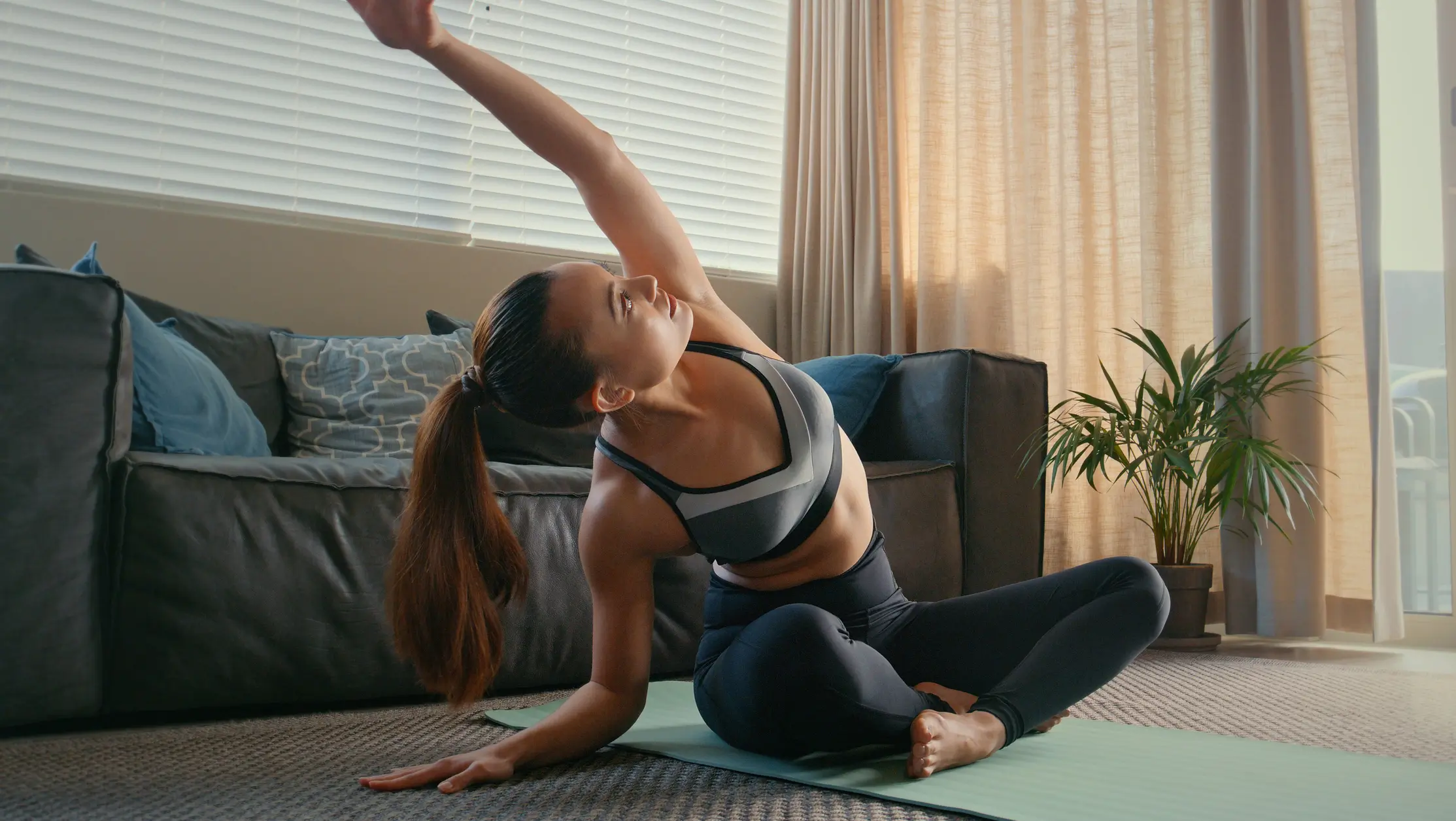
The great advantage of training at home is not that it is superior to a gym. It is that it removes negotiation. You do not need expensive equipment to feel challenged. You need a repeatable plan, a small amount of ingenuity and the willingness to let simple things become hard.
And if the missing piece is structure, that part is easier than many people think. Fitsse describes itself as a workout and nutrition platform that offers personalized training and meal guidance, and its official workout pages say users can customize plans by goal, fitness level, available equipment and session length, with guided routines and smart tracking built into the app. In practice, that makes it easy to have a workout program using the Fitsse app instead of trying to invent one from scratch every week.
Important notice: this content is educational and does not replace an individual evaluation. If you have a history of eating disorders, diabetes, pregnancy, or a medical condition, consult a healthcare professional before making dietary or exercise changes.






 Sign In