


There is a particular kind of clarity that arrives with early morning light: quieter rooms, the soft hiss of a kettle warming, and the unusual pleasure of moving before the obligations of the day take shape. For many people, the time before breakfast is an ideal window to establish a small, consistent practice that pays outsized dividends. A short core routine done in that hour does more than sculpt the midsection — it improves posture, steadies balance, protects the lower back, and makes every other lift or daily task feel easier.
Below are seven carefully chosen core exercises you can do at home with no equipment or with one small prop (a mat or a cushion). Each exercise includes what it trains, exact how-to cues, common mistakes, and sensible progressions. At the end you’ll find two sample routines — a five-minute express version and a twenty-minute fuller session — plus guidance on breathing, recovery, and how to fold this habit into a sustainable morning ritual.
Why a morning core routine matters
Before we jump to movement, a quick case for timing. Training the core in the morning has a few practical advantages:
- Consistency. Before the day’s meetings or errands get in the way, habits formed first thing are easier to keep.
- Neurological readiness. Light activity first thing raises heart rate slightly and primes the nervous system for the day.
- Injury prevention. Early mobility and core activation reduce stiffness from sleep and can lower the likelihood of back pain during the day.
- Psychological lift. Completing a short routine creates momentum; it’s a small win that makes other healthy choices likelier.
You don’t need a long session: even ten minutes, done three to five times a week, produces meaningful improvements in stability and control over months.
How to approach these exercises
A few ground rules to make the work efficient and safe:
- Quality over quantity. Better to do fewer deliberate reps than many rushed ones.
- Neutral spine. Except where the movement intentionally flexes, maintain a neutral lumbar curve. Avoid excessive tucking or hyperextension.
- Controlled breathing. Exhale during the effort (the “hard” phase) and inhale on the easier phase. This prevents breath-holding and stabilizes the torso.
- Progress gradually. If a movement is too hard, regress it; if it becomes easy, add time, reps, or a harder variation.
- Warm briefly if needed. Five gentle minutes of marching in place, hip circles, or cat-cow is enough to reduce stiffness.
With that, let’s get into the seven exercises.
1. The Front Plank (High-impact stability for the whole core)
What it trains: anterior abdominal wall, transverse abdominis, shoulders and glutes; teaches global trunk bracing.
How to do it:
- Start on forearms and toes (or knees for an easier version), elbows under shoulders and hands flat or clasped.
- Push the ground away to create long spine alignment from head to heels.
- Draw the ribs toward the pelvis gently — imagine zipping the lower belly toward the spine.
- Squeeze glutes and maintain steady breathing. Hold for time.
Volume: Beginners: 3 × 20–30 seconds. Intermediate: 3 × 45–60+ seconds.
Progressions: raise one leg briefly, move to high plank on hands, or add a shoulder tap (alternate brief hand lift).
Common mistakes: hips sagging or piking (hips too high), holding breath, jutting the chin up. Fix by recording a side view and shortening the hold while focusing on form.
2. Dead Bug (Controlled anti-extension for spinal safety)
What it trains: deep core stabilizers while training limbs to move independently — great for protecting the lower back.
How to do it:
- Lie on your back with arms straight up to the ceiling and knees bent at 90° (tabletop).
- Press the lower back gently into the floor and maintain that contact throughout.
- Slowly lower the opposite arm and leg toward the floor, keeping core engaged.
- Return to center and repeat on the other side.
Volume: 3 sets of 8–12 reps per side (slow and controlled).
Progressions: extend the range of motion (leg closer to the floor), add a small band around the feet for resistance, or hold a light dumbbell for the reaching arm.
Common mistakes: letting the lower back arch off the floor and rushing. Keep the movement deliberate; stop the rep when the lower back loses contact.
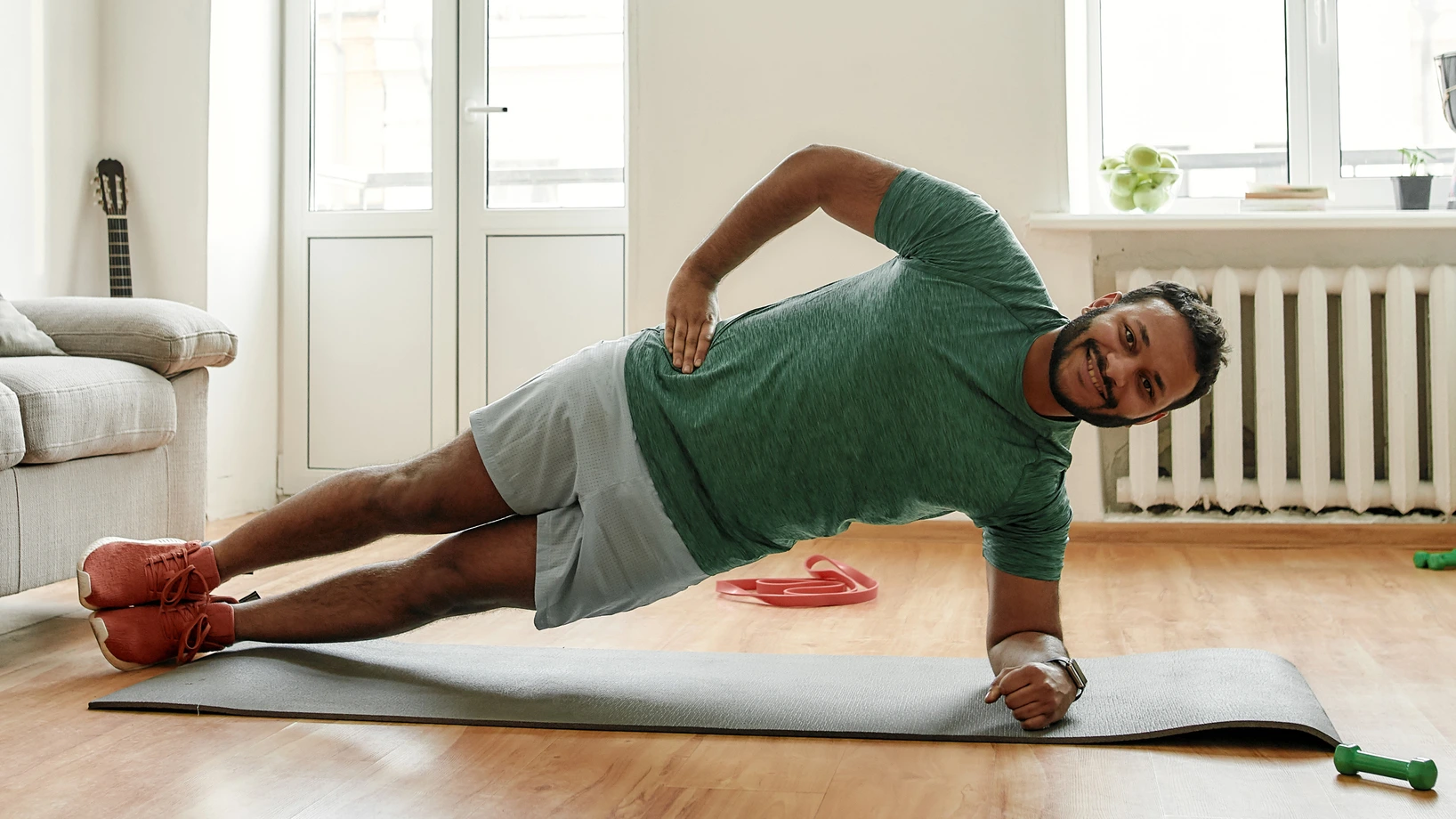
3. Side Plank (Lateral stability and oblique strength)
What it trains: obliques, lateral stabilizers, glute medius; supports side-to-side control.
How to do it:
- Lie on one side, forearm under shoulder and legs stacked. Lift hips until your body forms a straight line.
- Keep the top hip stacked over the bottom; don’t let it roll forward or backward.
- Hold for time. You may place the top hand on the hip or reach it overhead for a stability challenge.
Volume: 2–3 holds per side of 20–45 seconds; build gradually.
Progressions: raise the top leg, perform slow hip dips, or move to arm-straight side plank to add shoulder demand.
Common mistakes: allowing the hips to drop or rotating the torso. Cue: imagine a straight rod from head to heels.
4. Bird Dog (Contralateral control for coordinated strength)
What it trains: coordination of core with posterior chain: multifidus, glutes, shoulders; excellent for deadlift and running transfer.
How to do it:
- Begin on hands and knees with a neutral spine.
- Brace your core and extend the right arm forward and the left leg back until both are parallel with the floor.
- Keep hips level and avoid twisting. Pause briefly, then return and switch sides.
Volume: 3 sets of 8–12 reps per side.
Progressions: hold the extended position longer, or add a 2–4 second pulse at full extension.
Common mistakes: lifting the leg with hip hiking or rotating the hips. Keep moves slow and emphasize the connection between opposite arm and leg.
5. Glute Bridge (Posterior chain with core control)
What it trains: glutes, hamstrings, lower back, and requires core bracing to avoid lower-back overextension.
How to do it:
- Lie on your back, knees bent, feet flat hip-width apart.
- Brace your core and press through the heels to lift the hips until your body forms a straight line from shoulders to knees.
- Avoid arching the lower back; the motion should come from hip extension.
- Lower with control.
Volume: 3 sets of 10–15 reps.
Progressions: single-leg bridge, pause at the top, or add a light band above the knees for lateral stability work.
Common mistakes: overarching the lower back (hyperextension) or pushing through the toes instead of heels. Cue: press the floor away with your heels and squeeze the glutes.
6. Pallof Press (Anti-rotation for resilient torsos)
What it trains: deep core anti-rotation (transverse abdominis, obliques) and shoulder stability. Requires a band or cable; you can improvise with a towel and a fixed post though a band is best.
How to do it:
- Anchor a resistance band at chest height. Stand perpendicular to the band with feet hip-width apart.
- Hold the band with both hands at your chest. Step away to create tension.
- Press the band straight out in front of your chest, resist the rotational pull, then bring it back slowly.
- Keep the torso square and neutral.
Volume: 3 sets of 8–12 reps per side.
Progressions: hold the pressed position longer, increase band tension, or perform anti-rotation chops.
Common mistakes: allowing hips to rotate with the band. Fix by imagining a wall in front of your chest you cannot turn toward.
7. Hollow Hold (Core endurance and compressive strength)
What it trains: deep anterior core, the abdominal wall, and the ability to maintain tension — foundational for gymnastics and many athletic moves.
How to do it:
- Lie on your back. Press the lower back into the floor by tucking the pelvis slightly.
- Lift shoulders and legs off the ground just a few inches, arms extended overhead or by your sides.
- Keep the ribs drawn down and breathe steadily. Hold with steady tension.
Volume: beginners: 3 × 10–20 seconds. More advanced: 3 × 30–60 seconds or perform hollow rocks (small controlled rocking).
Progressions: reduce hip and shoulder height to make it harder, or add hollow to tuck transitions.
Common mistakes: letting ribs flare or the lower back lift. Cue: imagine zipping your belly toward your spine and pulling your ribs toward your pelvis.
Two sample routines: quick and full
Five-minute pre-breakfast express (do every morning if short on time)
- Quick warm-up: 1 minute marching in place with arm swings.
- Front plank: 30 seconds.
- Dead bug: 8 reps per side (1 minute).
- Side plank: 20 seconds per side (40 seconds).
- Glute bridge: 2 sets × 10 reps (rest as needed, ~1:15).
Total time: ~5 minutes.
Twenty-minute full morning routine (3–4× per week)
- Warm-up: 3 minutes (cat-cow, hip circles, gentle twists).
- Dynamic plank sequence: 45 seconds front plank + 20 seconds rest.
- Dead bug: 3 × 10 reps per side, 30 seconds rest.
- Bird dog: 3 × 8 reps per side, 20 seconds rest.
- Pallof press: 3 × 10 per side, 20 seconds rest.
- Side plank: 3 × 30 seconds per side, 20 seconds rest.
- Glute bridge: 3 × 12 reps.
- Hollow hold finish: 2 × 20–30 seconds.
- Cool down: 2 minutes deep breathing and gentle spinal roll.
Total time: ~18–22 minutes.
These templates are intentionally modular. On busier days, do the express version. On lighter mornings, savor the full sequence.
Breathing, tempo and cues that matter
Breathing is foundational. For most of these exercises, inhale during the preparatory or easier phase and exhale during the effort. For example, breathe in while lowering in a dead bug, exhale as you pull the limb back. Using a tempo — controlled second counts — helps: a 2-second lowering and 1-second lifting rhythm is a tidy rule of thumb for many movements.
Two practical cues that help you feel what you’re doing:
- “Brace, don’t hold.” Bracing engages the core without rigid breath-holding. Think of a firm but elastic belt around your waist.
- “Move from the hips, not the back.” Especially for bridges and bird dogs, initiate with glutes and hamstrings rather than hyperextending the spine.
Common mistakes and how to avoid them
Rushing through reps. Slow down and stop counting; watch your form. Ten deliberate reps are better than twenty sloppy ones.
Neglecting breathing. Hold a rhythm; it will raise performance and lower blood pressure spikes.
Ignoring pain that feels structural. Soreness is normal; sharp joint pain is not. Stop and reassess technique or consult a professional.
Doing only front work. Balance front planks with side and posterior chain work (bridges, bird dog) to avoid muscular imbalances.
How to build this into a long-term habit
Start small and stack habits. For example: after you brush your teeth, do the five-minute express routine. Keep a mat by your bed or a small note on the nightstand that says “move.” Track completion for 21–30 days — the visible chain of ticks is a powerful motivator.
Every four weeks, progress one variable: increase plank hold by 10–20 seconds, add two reps per side on dead bugs, or advance from bilateral to single-leg bridges. Small, consistent overload is the reliable path to improvement.
When to seek help
If you have a history of spinal surgery, persistent low back pain, herniated discs, or pregnancy-related diastasis recti, consult a physical therapist before starting. They can tailor regressions and progressions safely. Likewise, if an exercise produces sharp nerve pain, or a movement causes unusual dizziness or breathlessness, stop and seek medical guidance.
The small returns of a short morning practice
The appeal of morning core work is not vanity; it’s practical. A few weeks of regular, brief practice will likely leave you standing taller, feeling steadier when you walk or carry groceries, and moving through daily tasks with less low-back fatigue. These gains are quiet and cumulative: not a single dramatic event but a series of tiny advantages that add up.
Begin with curiosity rather than obligation. Try one of the routines for two weeks and notice what changes in posture, comfort, and energy. If you like the results, keep going. If it becomes rote, mix in new progressions or swap two exercises for fresh stimulus. The goal is not to make fitness another chore on a list, but to create a small, humane habit that supports all the other work of your day.
If you’d like, I can create a printable one-page routine, a four-week progression plan, or a short video script you can follow in the morning. Which would help you stick with it?
Important notice: this content is educational and does not replace an individual evaluation. If you have a history of eating disorders, diabetes, pregnancy, or a medical condition, consult a healthcare professional before making dietary or exercise changes.










 Sign In