

There’s a certain kindness to aerobics that modern fitness sometimes forgets.
It’s not trying to humble you with complexity. It doesn’t require a rack of equipment, a perfect playlist, or the moral purity of a brand-new routine. Aerobics is movement set to a rhythm—sometimes literal music, sometimes just the beat of your own breath—and it has always been built for ordinary spaces: living rooms, basements, garages, the rectangle of floor between the couch and the coffee table.
And maybe that’s why it still works. Aerobics is honest cardio: you move, your heart rate rises, you sweat, you recover, you do it again. The choreography can be simple, the energy can be bright, and the results—better stamina, better mood, better “I can handle the day”—are surprisingly real.
Below are seven aerobics-inspired sessions you can do at home this week. Each one is designed to be low on friction (minimal setup, easy to follow), but still high on payoff (you’ll breathe hard, build endurance, and leave with that unmistakable post-workout calm).
You can do these workouts on a mat, on carpet, or on a hard floor with supportive shoes. No equipment is required, though a towel and a water bottle help. If you’re returning to exercise after a long break, managing an injury, or unsure what’s safe for you, it’s wise to check with a clinician or qualified coach first.
Before You Start: A Few Ground Rules That Make This Work
Pick your impact level. Aerobics is not synonymous with jumping. You can get strong cardio benefits with low-impact moves (where one foot stays on the floor), especially if you move with purpose and keep transitions tight.
Use the talk test.
- Moderate: you can speak in short sentences.
- Hard: you can only get out a few words.
Aim for moderate-to-hard for the work portions, and let the recovery portions truly recover.
Make your space safer than your intentions.
- Clear a radius of about an arm’s length in all directions.
- If you’re on a slippery surface, wear shoes.
- If you’re downstairs from someone you like, choose the low-impact versions.
Warm up and cool down. Your body will forgive many things, but it resents being ambushed.
Quick Warm-Up (3 minutes)
- 30 seconds: march in place, easy
- 30 seconds: shoulder rolls and arm circles
- 30 seconds: side steps (step-touch), add gentle arm swings
- 30 seconds: knee lifts (slow), alternating
- 30 seconds: hip circles or gentle torso twists
- 30 seconds: march a little faster
Quick Cool-Down (2 minutes)
- 60 seconds: slow march → slow breathing (inhale 4, exhale 6)
- 30 seconds: chest opener (hands behind back or doorway stretch)
- 30 seconds: calf stretch against a wall or step
Now, the fun part.
Session 1: The “Classic” Low-Impact Cardio (Beginner-Friendly, Surprisingly Effective)
Time: 16 minutes
Vibe: bright, steady, doable on tired days
Format: 40 seconds work / 20 seconds easy march, repeat 2 rounds (8 moves)
Moves (Round 1 and Round 2)
- March in place (pump arms, stand tall)
- Step-touch + arm sweeps (side-to-side, arms wide like opening curtains)
- Grapevine (step side, cross behind, step side, tap) — switch direction halfway
- Knee lifts (alternate; add opposite elbow toward knee if comfortable)
- Hamstring curls (heel toward glutes; keep knees pointing down)
- Side knee lift (knee up to the side; small range is fine)
- V-step (step forward wide, step back narrow)
- Box step (step forward, step side, step back, step side—like walking a small square)
Make it easier: keep arms lower; slow the pace.
Make it harder: bigger arm movements; add a little “reach” overhead; tighten the 20-second recovery to a brisk march.
Why it works: steady-state cardio builds endurance and feels good without feeling punishing. This is the workout you do when you want to keep a promise to yourself.
Session 2: HI/LO Intervals (The Aerobics Class Staple)
Time: 18 minutes
Vibe: “I want sweat, but I want options.”
Format: 30 seconds high intensity, 30 seconds low intensity, repeat 3 rounds (6 total moves)
The key here is choice: “high” can mean impact or effort. You can keep it low-impact and still go hard.
The six pairs
- High: fast jacks or step jacks
Low: march + deep breaths - High: skaters (side-to-side) or side step with a deep reach
Low: step-touch - High: high knees or power march (drive knees up)
Low: easy march - High: squat pulses or sit-to-stand to a chair
Low: gentle side steps - High: mountain climbers or incline climbers on a couch
Low: slow march - High: “speed bag” arms + quick feet or fast feet without leaving the floor
Low: walk it out
Repeat the sequence three times. You’ll finish feeling like you did something.
Make it easier: keep everything low-impact; shorten to 2 rounds.
Make it harder: during “high” intervals, try to reach a breathless pace while keeping form clean.
Why it works: interval training teaches your body to recover. That recovery ability is what makes daily life feel easier—walking, climbing stairs, keeping up.
Session 3: Dance-Cardio Without the Intimidating Choreography
Time: 15–18 minutes
Vibe: joyful, rhythmic, slightly theatrical
Format: 3 blocks of simple combos, each repeated long enough to feel natural
You don’t need to “know how to dance.” You need to be willing to repeat a pattern until it clicks—and to let it be imperfect.
Block A (5 minutes): The “Four Corners” Combo
Repeat continuously:
- 2 step-touches right
- 2 step-touches left
- 4 marches forward
- 4 marches back
Add arms: reach forward, then sweep back like you’re pulling air behind you.
Block B (5 minutes): The “Grapevine + Punch” Combo
Repeat continuously:
- Grapevine right (4 counts) + 2 light punches forward
- Grapevine left (4 counts) + 2 light punches forward
Keep punches at chest level; rotate gently through the torso.
Block C (5 minutes): The “Knee + Kick” Combo
Repeat continuously:
- 2 knee lifts
- 2 front kicks (low, controlled)
- 4 fast marches
Add arms: pull elbows down on knee lifts, reach forward on kicks.
Make it easier: reduce arm movements; keep kicks low; slow the tempo.
Make it harder: increase range of motion; tighten transitions; add a light bounce if impact feels good.
Why it works: rhythm reduces perceived effort. You’re working, but your brain experiences it as play. That’s a powerful compliance tool.
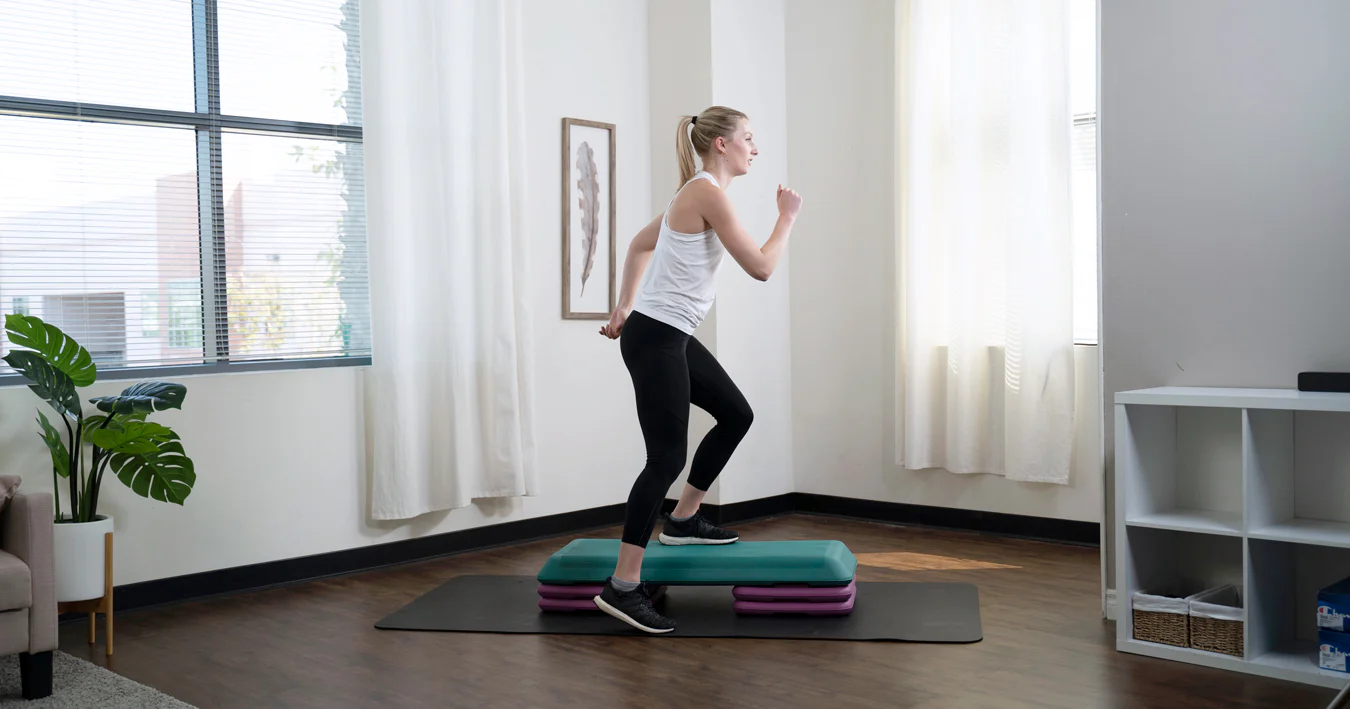
Session 4: At-Home Step Aerobics Using One Stair (or a Sturdy Step)
Time: 16–19 minutes
Vibe: classic cardio, legs-on-fire in a satisfying way
Format: 45 seconds work / 15 seconds rest, 6 moves, 3 rounds
Use the bottom stair in your home, a sturdy step, or even a thick platform—stable matters more than height.
Moves
- Basic step-up (alternate lead legs)
- Step-up + knee lift (step up, lift knee, step down)
- Corner-to-corner (step up wide, step down wide—like a gentle “V”)
- Tap-ups (tap one foot on the step quickly, alternating)
- Lateral step-over (step up sideways, step down, return—go slow at first)
- Slow climber (step up-up-down-down, steady rhythm)
Make it easier: reduce step height; slow down; hold a railing lightly for balance.
Make it harder: increase tempo; add bigger arm swings; keep rest to 10 seconds.
Why it works: step work is deceptively intense because it’s repetitive leg strength plus cardio—an old-school combination that still holds up.
Session 5: Cardio Kickboxing, Aerobics-Style (Stress Relief Included)
Time: 17 minutes
Vibe: focused, cathartic, strong
Format: 1-minute rounds, 30 seconds rest, 10 total rounds
This is not about fighting. It’s about moving with intention. Keep punches controlled—shoulders relaxed, wrists straight.
Rounds
- Jab–jab–cross (repeat, switch stance halfway)
- Front knee strikes (alternate knees; hands “frame” the face)
- Side steps + hooks (step right with a hook, step left with a hook)
- Squat + uppercut (small squat, rise with alternating uppercuts)
- Front kicks (low and controlled)
- Fast feet + jabs (low impact is fine; think quick shuffles)
- Cross + knee (cross punch, then same-side knee)
- Shadow boxing freestyle (mix punches; keep moving)
- Plank hold or incline plank (steady breathing)
- Victory round: your favorite combo (or repeat Round 1)
Make it easier: keep stance narrower; reduce kick height; do incline plank.
Make it harder: add speed while staying controlled; keep hands up; shorten rest.
Why it works: it’s cardio plus coordination plus emotion regulation. There’s something deeply settling about punching the air with a plan.
Session 6: The “Light Weights” Aerobics Burner (Optional Water Bottles)
Time: 18–20 minutes
Vibe: sculpt + sweat without turning into a full strength session
Equipment: 1–3 lb dumbbells, or water bottles (optional)
Format: 40 seconds work / 20 seconds rest, 8 moves, 2 rounds
Use light weights. Aerobics-style weight work is about endurance, not max strength.
Moves
- March + overhead press
- Step-touch + lateral raises (lift arms to shoulder height)
- Grapevine + biceps curls
- Knee lifts + alternating punches
- Squat + front raise (raise arms forward to shoulder height)
- Hamstring curls + triceps kickbacks
- Fast march + “goalpost” pulls (elbows bent, pull back)
- Standing core twist + light punches (rotate gently, controlled)
Make it easier: drop weights; keep arms below shoulder height.
Make it harder: keep the pace brisk; make the 20-second “rest” a slow march instead of full rest.
Why it works: combining light resistance with constant movement builds stamina in the muscles that support posture—shoulders, upper back, core—while still training your heart.
Session 7: The 12-Minute Aerobics Finisher (Short, Sharp, Effective)
Time: 12 minutes
Vibe: quick, spicy, perfect when you’re tempted to skip
Format: 20 seconds hard / 10 seconds easy (aerobics-style “Tabata-ish”), 6 moves
You’ll do each move for 4 rounds before moving to the next one:
- 20 seconds “work”
- 10 seconds “easy march”
That’s 2 minutes per move, 12 minutes total.
Moves
- Power march (drive arms; tall posture)
- Step jacks (or jumping jacks if you want impact)
- Skaters (low impact or a light hop)
- Squat to reach (squat, stand, reach overhead)
- Knee lift + twist (alternate sides)
- Fast feet (tiny steps, quick rhythm)
Make it easier: keep everything low-impact; reduce squat depth.
Make it harder: increase range of motion and speed; choose jumping jacks and hop skaters.
Why it works: short intervals can deliver big cardio benefits because they ask for focused effort—then grant just enough recovery to do it again.
How to Make These Workouts Build “Real Fitness” (Not Just a One-Off Sweat)
Aerobics can be more than a nostalgia workout. If you want results you can feel—more stamina, better conditioning, steadier mood—use this simple progression:
Pick a weekly structure
Option A: 3 days/week
- Day 1: Session 1 or 3 (steady, skill-building)
- Day 2: Session 2 or 7 (intervals)
- Day 3: Session 4 or 5 (legs or kickboxing)
Option B: 4 days/week
- Two steady sessions (1 and/or 3)
- One interval session (2 or 7)
- One “specialty” session (4, 5, or 6)
Progress one variable at a time
- Add one extra round, or
- Reduce rest slightly, or
- Make movements bigger (not sloppier), or
- Add impact only if your joints feel good
Fitness grows when the challenge grows gradually—like a story, not a plot twist.
The Real Gift of Aerobics
It’s easy to talk about cardio in terms of metrics: heart rate zones, VO₂ max, calories burned. Those things have their place. But the quieter benefits are often the ones that keep people coming back.
Aerobics gives you rhythm. It gives you momentum. It gives you a small sense of agency—your body doing what you ask it to do, your breath getting steadier, the day feeling slightly more manageable afterward.
And in a world that often makes wellbeing feel like an expensive hobby, there’s something almost radical about moving at home, on your own terms, for no other reason than this: it helps.
If you’d like, tell me your fitness level (beginner / intermediate), whether you prefer low-impact only, and how many days per week you want to train—and I’ll turn these seven sessions into a 4-week at-home plan with progression that still feels simple.
Important notice: this content is educational and does not replace an individual evaluation. If you have a history of eating disorders, diabetes, pregnancy, or a medical condition, consult a healthcare professional before making dietary or exercise changes.









 Sign In