


Chairs have a reputation problem. They are blamed — sometimes fairly — for stiff hips, sore backs and the slow shrinkage of our daily movement. But a chair is also where many of us spend our lives: at work, in transit, at the kitchen table, in waiting rooms, in the quiet minutes when we’re too tired to negotiate with the floor.
Which is why chair yoga can feel like a small act of realism. It doesn’t ask you to become a different person with a pristine schedule and a foam roller collection. It asks only that you sit down — and then, with some intention, move.
For people with tight hips, chair yoga offers something especially useful: supported mobility. The chair gives you leverage. It reduces fear of falling. It makes balance less dramatic. It lets your nervous system experience stretch and movement without the background alarm of “What if I tip over?” And for many people, that safety is the first ingredient in flexibility.
The second ingredient is breath.
A calmer nervous system doesn’t come from forcing yourself to relax. It comes from giving your body signals that it is safe — slow breathing, gentle movement, predictable rhythms, and positions that don’t feel like a fight. When the nervous system downshifts, muscles often unclench. When muscles unclench, hips usually move better. The chain is not mystical; it’s biological.
This article offers six chair-based yoga exercises designed for stiff hips and a steadier nervous system — plus a simple routine you can do in 10 to 20 minutes. It’s written for real people: people who sit a lot, people who feel creaky, people who carry stress in their bodies, people who want to move without turning it into another project.
Before we begin, two notes that matter.
First: discomfort is not a badge. None of these should cause sharp pain, numbness, tingling, or joint pinching. You should feel mild stretch, warmth, or effort — not warning signals. If something feels wrong, adjust, reduce range of motion, or skip it.
Second: when we talk about “calming the nervous system,” we’re not talking about erasing anxiety on command. We’re talking about shifting the body toward a more regulated state — quieter breathing, lower tension, less bracing, a little more room to move.
All you need is a sturdy chair (no wheels, ideally), enough space to move your arms, and a few minutes that belong to you.
Why Hips Get Stiff (And Why It’s Not Just “Tightness”)
Hip stiffness is rarely a single thing. It’s often a combination of:
- prolonged sitting (hips held in flexion for hours),
- underused glutes (hip extensors that get sleepy),
- protective muscle tension from stress,
- limited rotation in the hip joint,
- and sometimes a body that’s simply been asked to do too much, too fast.
The hips are a crossroads. They connect legs to trunk. When they’re restricted, other areas take over: the lower back works harder, the knees feel crankier, walking feels less fluid. But hips also respond well to gentle, consistent input. You don’t have to overhaul your life to see change. You have to introduce movement and do it often enough to matter.
Chair yoga is good at this. It meets you where you are — literally.
A Simple Framework: Breath First, Then Movement
If you’ve ever tried to stretch while stressed, you already know the problem: the body resists. The nervous system treats intensity as threat. So start with breath, then move.
A useful breathing pattern for downshifting is longer exhale than inhale. You can do this without turning it into math:
- Inhale through the nose for about 3–4 seconds
- Exhale slowly through the mouth for about 5–7 seconds
Do that for a minute, and you’ll usually feel something soften — in the shoulders, the jaw, the belly. That softening is a signal. It tells your hips: we’re not in a rush.
You can weave this breath into every exercise below.
1) Seated Pelvic Tilts (The “Unstick Your Lower Back” Move)
This is not glamorous, which is a point in its favor. Pelvic tilts restore awareness of how your pelvis moves — and the pelvis is the foundation for hip motion.
When hips feel stiff, people often lock into one posture: either slumped (posterior tilt) or overarched (anterior tilt). Pelvic tilts give you the middle ground.
How to do it
- Sit near the front edge of the chair, feet flat and hip-width apart.
- Place hands on your hips or lower belly.
- Exhale and gently tuck your tailbone under (feel your lower back widen).
- Inhale and gently tip the pelvis forward (feel the sitting bones point back; keep it small).
- Move slowly, like you’re rocking a bowl of water without spilling it.
What you should feel
A subtle movement in the pelvis and low back — not strain.
Why it helps stiff hips
Pelvic motion and hip motion are married. When the pelvis stops moving, hips tend to feel “stuck.” This reintroduces control and reduces guarding.
Do it for
- 8–12 slow cycles
- Or 60 seconds with your breath
2) Seated Figure-Four Stretch (A Hip External Rotation Classic)
If your hips are stiff from sitting, the outer hip — glute muscles and deep rotators — often feels like it’s been holding tension all day. The seated figure-four targets that area gently.
How to do it
- Sit tall near the front of the chair.
- Place your right ankle on your left thigh, just above the knee (foot flexed).
- Keep your spine long. Inhale to lengthen.
- Exhale and hinge forward slightly from the hips (not rounding your back).
- Stop when you feel a stretch in the right outer hip.
Adjustments (important)
- If placing the ankle on the thigh is uncomfortable, move it closer to the knee, or simply rest the ankle on the shin.
- Keep the foot flexed to protect the knee.
- If your knee feels strained, reduce the angle or skip this pose.
What you should feel
A stretch in the outer hip and glute, not in the knee joint.
Do it for
- 5–8 breaths each side (slow exhale)
Why it helps the nervous system:
Forward hinging with slow breathing often triggers a mild calming response — your body interprets it as non-threatening, especially when supported.
3) Seated Hip Circles (Gentle Rotation to Lubricate the Joint)
Hips are designed to rotate. Sitting reduces that rotation. Hip circles reintroduce movement in a way that’s more like daily life: subtle, multi-directional, low intensity.
How to do it
- Sit tall, hands resting on thighs.
- Lift the right knee slightly (or keep foot lightly on the floor if lifting is too hard).
- Begin making small circles with the knee: outward, then inward.
- Keep the movement smooth and slow.
What you should feel
A sense of the hip joint moving more freely, like warming up a stiff hinge.
Do it for
- 6–10 circles each direction per side
- Keep circles small and controlled
Tip: Pair with breath — exhale on the harder part of the circle.
4) Seated Lunge Stretch (Chair-Assisted Hip Flexor Release)
Hip flexors — the muscles at the front of the hip — often feel tight from prolonged sitting. When they’re stiff, standing tall can feel like a mild backbend, and the lower back compensates. A gentle hip flexor stretch can change the whole posture.
This chair-assisted version reduces balance demands and lets you control intensity.
How to do it
- Sit sideways on the chair so your right hip is near the edge.
- Slide your right leg back behind you, toes tucked under if comfortable.
- Keep your left foot planted on the floor.
- Hold the chair lightly for support.
- Gently draw your ribs down and squeeze your right glute slightly — this is key.
- You should feel a stretch at the front of the right hip.
Common mistake
Arching the low back instead of stretching the hip. Keep the ribs stacked over the pelvis and use a gentle glute squeeze.
Do it for
- 5–8 slow breaths per side
Why it calms the nervous system:
When hip flexors release, the body often stops “bracing” in the front of the hips, which can reduce that subtle fight-or-flight posture.
5) Seated Pigeon-Inspired Fold (A Softer Variation for Tight Hips)
Traditional pigeon pose on the floor can be too intense — and for some bodies, it simply doesn’t feel safe. This chair version offers the spirit of the pose (outer hip opening) without the drama.
How to do it
- Set up the figure-four position again: ankle on opposite thigh, foot flexed.
- Place one hand on your shin and one on your hip.
- Inhale to lengthen your spine.
- Exhale and hinge forward slightly, keeping your chest open.
- If it feels good, let your torso come closer to your shin — but only as far as you can stay relaxed.
What you should feel
A deep stretch in the glute/outer hip. You should be able to breathe without grimacing.
Do it for
- 6–10 breaths per side
A note on effort:
If your face is working harder than your hips, you’ve gone too far.
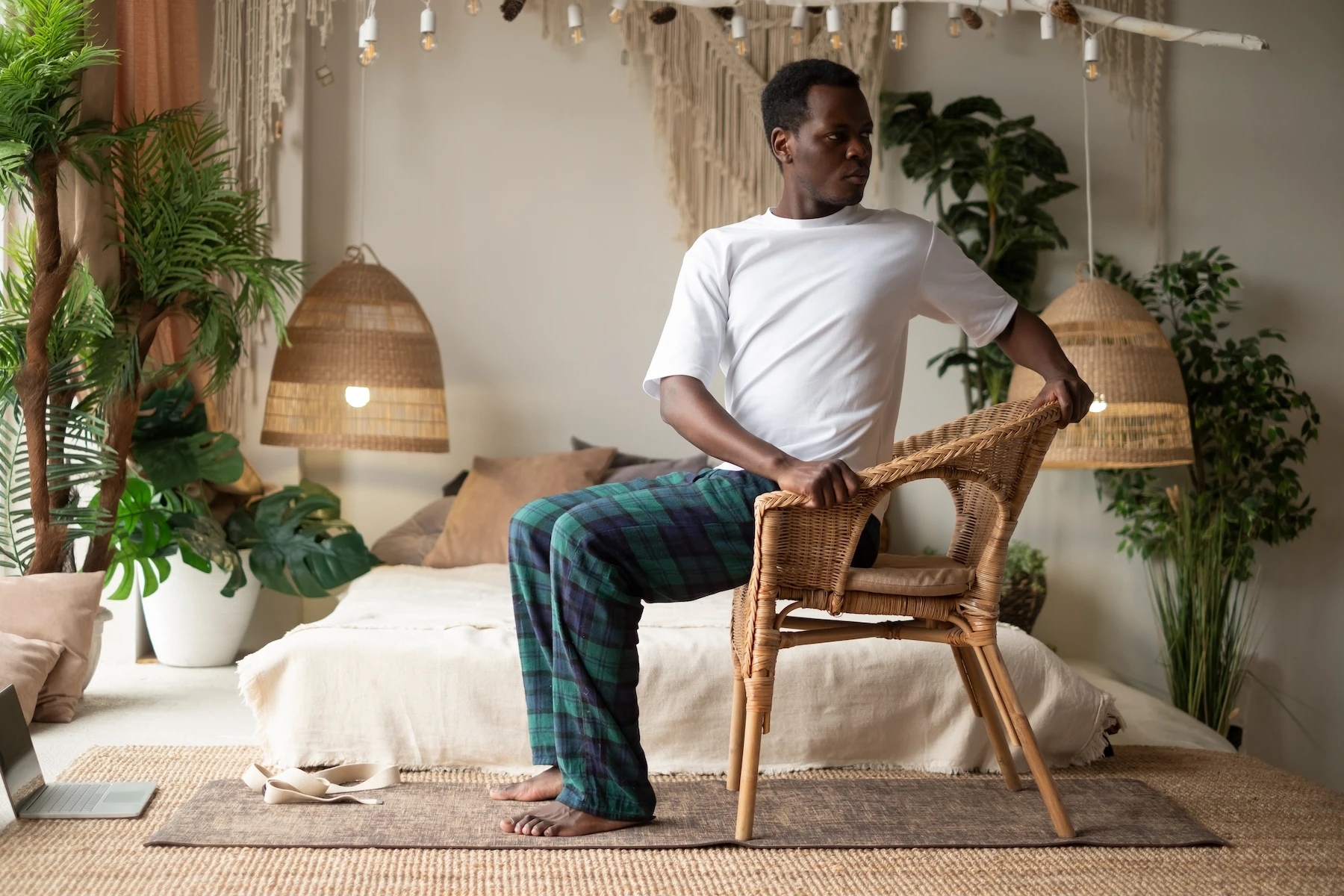
6) Seated Twist With Breath (To Quiet the Body’s “Guarding”)
Hip stiffness isn’t only local. When the nervous system is keyed up, the whole body becomes protective. Twists can be calming because they combine gentle muscular engagement, breathing, and a slow rhythm.
This twist also mobilizes the thoracic spine — the upper back — which often compensates when hips are stiff.
How to do it
- Sit tall, feet flat.
- Place your right hand on the outside of your left thigh.
- Place your left hand behind you on the chair (or hold the seat).
- Inhale to lengthen your spine.
- Exhale and rotate gently to the left, keeping shoulders relaxed.
- Keep your gaze soft — no need to crank.
Do it for
- 5 slow breaths per side
Nervous system cue:
On each exhale, imagine your shoulders melting downward. It’s a small gesture of safety.
Put It Together: A 12-Minute Chair Yoga Routine (Hips + Calm)
If you only do one thing from this article, do this routine. It’s short enough to repeat, and repetition is what changes bodies.
1) Breath reset (1 minute)
Inhale 3–4 seconds, exhale 5–7 seconds.
2) Seated pelvic tilts (1 minute)
Slow and gentle.
3) Seated hip circles (2 minutes)
1 minute each side.
4) Figure-four stretch (4 minutes)
2 minutes each side (or 6–10 breaths each).
5) Seated lunge stretch (2 minutes)
1 minute each side.
6) Seated twist (2 minutes)
1 minute each side.
That’s it. If you have more time, repeat the figure-four or lunge stretch, or simply sit and breathe for another minute at the end.
How Often Should You Do It?
Here’s the surprising answer: often beats long.
- 10–12 minutes most days beats one intense session once a week.
- If your hips are very stiff, do the routine daily for two weeks and then reassess.
- If you sit for work, try doing one or two exercises (pelvic tilts, hip circles, twist) as “movement snacks” during the day.
Your hips respond well to gentle reminders that they are allowed to move.
What to Watch For: When a Stretch Isn’t the Answer
Stiffness can sometimes be a form of protection. The body tightens because it doesn’t trust a range of motion. In those cases, forcing flexibility can backfire. You might feel looser for an hour and then tighter later.
If that’s you, mix mobility with light strength:
- Seated marches (lifting one knee at a time)
- Sit-to-stand from the chair
- Gentle glute squeezes
Strength is often the nervous system’s favorite form of flexibility.
A Few Small Choices That Make This Work Better
Make the chair stable
No wheels. Feet planted. The calmer your environment, the calmer your body.
Keep your jaw unclenched
It sounds unrelated, but it isn’t. Jaw tension is often a nervous system tell. Relaxing it can help the whole body downshift.
Breathe out like you mean it
The exhale is your remote control. A longer exhale signals “safe enough.”
Don’t chase “deep”
Chair yoga is not a contortion contest. The goal is to feel better when you stand up.
Notice the after-effect
The real test isn’t how far you fold. It’s whether walking feels easier, whether standing tall feels less effortful, whether your hips feel more spacious.
The Larger Point: Calm Is a Physical Skill
We often talk about calm as if it’s a personality type. Some people are calm; others are not. But calm is also physiological. It can be practiced — not through force, but through repetition.
A chair, a slow breath, a few minutes of supported movement: these are small inputs. Their power is cumulative. Do them enough times and the body starts to learn a new baseline — less bracing, less guarding, a little more ease in the hips.
It won’t fix everything. Nothing does. But it can shift the day in a way that is quietly significant: you get up from your chair and feel less like you’re unfolding, less like you’re negotiating with your joints, more like you’re simply standing.
And in a culture that treats feeling good as something you have to earn with intensity, chair yoga offers a gentler proposition: you can start where you are, use what you have, and still change how your body feels.
That’s not dramatic. It’s practical. Which, for most of us, is the kind of wellness that actually lasts.






 Sign In