

The step goal has become a kind of modern moral scorecard. Ten thousand steps says: I tried today. I chose movement over inertia. I did the thing that counts.
Walking deserves its reputation. It’s accessible, joint-friendly for many people, good for the heart, good for the head. But steps also have a quiet limitation: they’re mostly more of the same. The same forward motion. The same planes of movement. The same muscles taking their familiar turns while other parts of the body — shoulders, hips, ankles, the small stabilizers you only notice when they fail you — live in relative silence.
And then there are the days when you’ve already walked plenty. You’ve paced through meetings, errands, childcare, commuting, stress. Your legs did their duty, but your nervous system is still buzzing. Your back still feels like an unresolved email.
This is where yoga can be the better bargain.
Not because it’s superior to walking in some grand, universal way — it isn’t. But because yoga can target what another 10,000 steps often doesn’t: mobility in neglected joints, strength in overlooked patterns, balance, breath, and the ability to downshift when your day has left you stuck in “go.”
What follows are five flows designed for real life: the small apartment, the hotel room, the corner of a living room that smells faintly like yesterday. Each one is meant to feel like a complete thought — not a vague suggestion to “stretch more,” but a sequence you can do, repeat, and progress. Think 12 to 25 minutes. Think less about performance and more about effect.
A small note, because it matters: pain is not a prerequisite. Discomfort can be information; sharp pain is a stop sign. Modify freely, use props shamelessly, and if you’re managing an injury, pregnancy, dizziness, or a medical condition, get guidance that fits your body.
How to Use These Flows
- Pick based on what you need, not what you “should” do.
Tight hips? Choose the desk detox. Fried nerves? Choose the reset. - Keep your breathing boring.
In through the nose if you can, out a little longer than the inhale. If you lose your breath, you’re probably rushing. - Aim for “steady,” not “dramatic.”
Yoga backfires when it becomes a performance. You’re here for sensation and control, not a photograph.
You’ll also notice something: these flows move you in multiple directions — side-to-side, rotation, extension, balance — all the things walking doesn’t ask of you. That variety is the point.
Flow 1: The Morning Spine-and-Breath Primer (When Your Body Wakes Up Stiff)
This is the antidote to that early feeling that your spine spent the night folded into a question mark. It’s not a workout; it’s a reintroduction. It builds gentle heat, opens the front body, and reminds your breath where it lives.
Time: 12–18 minutes
Props: Optional blanket under knees, block for hands
The Sequence
- Constructive Rest + Breath (1–2 minutes)
Lie on your back, knees bent, feet on the floor. Place one hand on ribs, one on belly. Inhale gently into the side ribs. Exhale longer than you inhale.
Cue: Let the exhale feel like a soft closing, not a push. - Knees-to-Chest, One at a Time (1 minute)
Draw right knee in, then left. Small circles at the hip.
Why it works: It’s a low-stakes way to check in: tight hip flexors, cranky low back, general “not yet.” - Supine Twist (1 minute each side)
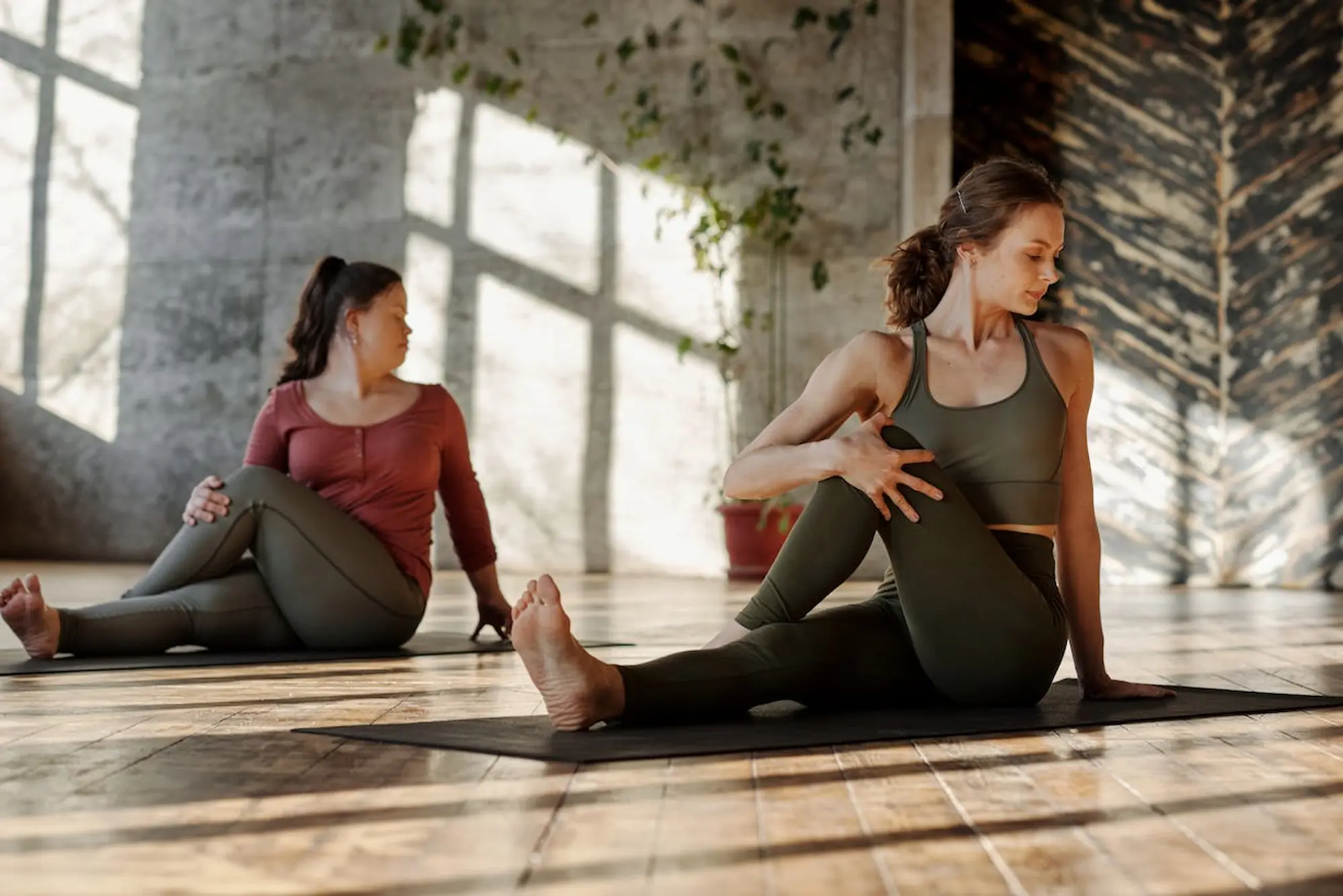
Arms out like a “T.” Knees to chest, drop them to the right, then left. Keep shoulders heavy.
Modify: Place a pillow between knees. - Cat–Cow (1–2 minutes)
Come to hands and knees. Inhale: arch. Exhale: round.
Cue: Let movement originate from the pelvis; the head follows. - Thread-the-Needle (45 seconds each side)
From all fours, slide right arm under left, shoulder to floor, hips stay over knees. Then switch.
Why it works better than steps: Walking rarely gives your upper back the rotation it quietly needs. - Low Lunge With Gentle Pulses (1 minute each side)
Step right foot forward, left knee down. Hands to thigh. Small pulses forward and back.
Cue: Keep the ribs stacked over the pelvis. Don’t spill forward. - Half Split (45 seconds each side)
From low lunge, shift hips back, straighten front leg, flex toes.
Modify: Bend the front knee; you’re aiming for hamstring sensation, not strain. - Downward Dog to Plank Waves (5 slow reps)
Down dog. Inhale to plank. Exhale back to down dog.
Why it works: Strengthens shoulders and core in a controlled way — the kind of stability walking doesn’t train much. - Rag Doll Forward Fold (1 minute)
Feet hip-width. Hang, bend knees generously, hold opposite elbows.
Cue: Think “heavy head, soft jaw.” - Mountain Pose + One Breath Cycle (30 seconds)
Stand tall. Inhale: feel length. Exhale: feel grounded.
What This Flow Does That Steps Don’t
It restores spinal motion (flexion, extension, rotation) and asks your shoulders to stabilize. You finish feeling taller — not because you forced posture, but because the front body isn’t clinging for dear life.
Flow 2: The Desk Detox Hip-and-Shoulder Flow (When Sitting Has Taken Over)
This is for the modern posture: hips locked, chest collapsed, neck forward, glutes on vacation. Another long walk can help, sure — but it won’t necessarily undo the shape of eight hours in a chair.
Time: 15–22 minutes
Props: A strap or towel; optional block
The Sequence
- Seated or Standing Shoulder Opener (1 minute)
Interlace fingers behind your back, straighten arms gently, lift chest.
Modify: Hold a strap or towel if interlacing is awkward. - Neck “Yes/No/Maybe” (1 minute)
Slow nods, slow turns, tiny ear-to-shoulder tilts.
Cue: Keep it small. Neck mobility is persuasion, not conquest. - Half Sun Salutations (3 rounds)
Inhale arms up, exhale fold, inhale half lift, exhale fold, inhale rise.
Why it works: You start generating heat without rushing. - Chair Pose With Heel Lift (5 breaths)
Sit hips back. Lift heels slightly, then lower.
Cue: Keep knees tracking over middle toes. - Lunge + Twist (1 minute each side)
Step right foot back into a high lunge. Left hand to thigh, right arm rotates up. Switch sides.
Modify: Drop the back knee. - Warrior II + Reverse Warrior (5 breaths each side)
Open hips. Hold Warrior II, then reach up and back.
Cue: Keep your front knee bent and honest. - Pigeon or Figure-Four (2 minutes each side)
- Pigeon: Front shin angled, back leg extended.
- Figure-Four: On your back, ankle on opposite knee, draw legs in.
Choose the one your knees prefer.
- Sphinx Pose (1 minute)
Lie on belly, forearms down, chest forward.
Why it works: Sitting rounds you; sphinx is a gentle rebuttal. - Child’s Pose With Side Stretch (1 minute each side)
Walk hands to one side, breathe into side ribs.
What This Flow Does That Steps Don’t
It targets hip external rotation and thoracic extension — the stuff that keeps your gait from becoming stiff and your shoulders from creeping into your ears. It also quietly trains you to breathe into the ribcage again, instead of shallow-chesting through the day.
Flow 3: The “Leg Day” Standing Strength Flow (When You Want Results Without Equipment)
If your step count is already high, your legs may have endurance but not necessarily strength. Walking is repetitive, mostly submaximal. This flow asks for controlled effort — the kind that builds capacity you can feel climbing stairs, lifting groceries, or simply standing without fatigue.
Time: 18–25 minutes
Props: Optional block for balance
The Sequence
- Warm-Up: Down Dog Pedal + Calf Pulses (1–2 minutes)
Bend one knee, straighten the other. Then both heels lift and lower slowly. - Chair Pose Holds (2 rounds of 5–8 breaths)
Sit back, weight in heels.
Cue: Think “ribs down,” so your low back doesn’t steal the show. - Crescent Lunge With Knee Drive (8 slow reps each side)
High lunge. Shift weight into front foot. Bring back knee toward chest. Then step back again.
Why it works: It’s strength plus balance — a rare combo in daily life. - Warrior III Prep (5 breaths each side)
From lunge, hinge forward, lift back leg, hands to blocks or floor.
Modify: Keep fingertips on a wall. You’re not auditioning for anything. - Goddess Squats With Pulses (30–45 seconds)
Wide stance, toes out. Sink, pulse tiny.
Cue: Knees track with toes; keep chest proud. - Side Angle to Half Moon Transition (3 slow tries each side)
From Warrior II, forearm to thigh (side angle). Then shift forward into half moon (hand to block).
Why it works: Lateral hip strength and balance — two ingredients many people miss until a knee complains. - Bridge Pose Hold (45–60 seconds)
Lie down, feet close to hips, lift.
Option: One leg lifts for a few breaths if stable. - Happy Baby (1 minute)
Knees wide, hold feet or shins, gentle rock.
What This Flow Does That Steps Don’t
It strengthens the legs in multiple planes: squat, lunge, hinge, lateral stability. It also forces coordination — the kind that keeps you resilient when you’re tired, distracted, or moving fast.
Flow 4: The Nervous-System Reset Flow (When Your Brain Won’t Stop Walking)
There’s a specific kind of restlessness that steps can’t solve: you can walk 12,000 steps and still feel wired. The body has moved, but the mind is still sprinting. This flow is designed to change the internal tempo.
It’s slow on purpose. It uses longer exhales, supported shapes, and gentle forward folds to cue a “downshift.” Think of it as the opposite of doomscrolling: attention trained on one thing, then another, then the breath.
Time: 15–20 minutes
Props: Blanket, pillow, or two blocks
The Sequence
- Seated Breath With Extended Exhale (2 minutes)
Inhale for 4, exhale for 6 (or whatever feels natural).
Cue: The goal is calm, not a contest. If you feel air hunger, shorten it. - Cat–Cow, Very Slow (1–2 minutes)
Move like you’re underwater. - Puppy Pose (1 minute)
From all fours, walk hands forward, hips above knees, chest toward floor.
Modify: Place a blanket under chest or forehead. - Low Lunge With Hamstring Emphasis (1 minute each side)
Not big. Not deep. Just breath and sensation. - Wide-Knee Child’s Pose (2 minutes)
Knees wide, big toes touch. Let belly rest.
Why it works: It’s a posture of surrender that doesn’t feel like collapsing. - Legs Up the Wall (3–5 minutes)
Scoot hips toward wall, legs up.
Modify: Place a pillow under hips or do it on the couch with legs on the backrest. - Supine Bound Angle (2 minutes)
Soles of feet together, knees fall open. Support knees with pillows. - Final Rest (2 minutes)
No achievement required. Let your face soften.
What This Flow Does That Steps Don’t
It addresses stress physiology — the part of weight management that people nod at politely and then ignore. This flow helps you practice coming down from “productive” and into “regulated,” which influences cravings, sleep, and the kind of decision-making that doesn’t happen when you’re fried.
Flow 5: The Sleep-Friendly Unwind Flow (When Another Walk Would Keep You Up)
Sometimes the late walk is helpful. Sometimes it becomes a second wind. Your body is tired but your nervous system interprets movement as a cue to stay alert. This flow is built for the hour before bed, when the goal is not fitness as spectacle — it’s sleep as strategy.
Time: 12–18 minutes
Props: Blanket, pillow, bolster if you have one
The Sequence
- Supported Forward Fold (2 minutes)
Sit with legs crossed or extended. Place a pillow on your thighs. Fold onto the pillow.
Cue: Let the spine round. This is not a “stretch”; it’s a pause. - Reclined Twist (1–2 minutes each side)
Same as earlier, but slower. If thoughts arrive, let them pass like traffic. - Hamstring Strap Stretch (1 minute each side)
Lie down, strap around foot, leg up. Keep the other knee bent.
Modify: Bend the raised knee. The nervous system prefers gentleness at night. - Knees-to-Chest + Rock (1 minute)
A small, soothing motion. - Supported Child’s Pose (2 minutes)
Pillow under chest, forehead on something soft. - Seated “Box Breathing” Variation (2 minutes)
Inhale 4, hold 2, exhale 6, hold 2. (Adjust as needed.)
Cue: Make the exhale the longest part. - Savasana With Weight (3–5 minutes)
Lie down. Place a folded blanket over the hips or abdomen.
Why it works: A little pressure can feel grounding, like a gentle “stay here.”
What This Flow Does That Steps Don’t
It teaches your body to interpret stillness as safe. It’s not about stretching deeply; it’s about reducing internal noise — which is often what keeps people snacking, scrolling, or lying awake bargaining with tomorrow.
Why These Flows Can “Work Better” Than More Steps
Not better as virtue. Better as targeting.
Walking is brilliant at what it does: steady-state movement, low barrier, decent mood lift, often sustainable. But yoga can be more efficient for a different set of outcomes that matter to weight management and health:
- Strength and muscle retention.
Several of these flows ask you to hold your own body weight in ways walking rarely does. - Mobility and joint variety.
Hips, ankles, thoracic spine, shoulders — all get invited into the conversation. - Stress downregulation.
Not spiritual, not mystical — practical. A calmer nervous system makes better choices easier. - Body awareness.
Yoga teaches you what “enough” feels like — and what’s actually happening in your body, not just what an app reports.
If the phrase “works better” bothers you, good. It should. The truth is more interesting: movement isn’t one thing. It’s a set of tools. And the most effective habit is the one that fits your life, your body, and your day.
How to Make These Flows Feel Like They’re Doing Something
If you’ve ever tried yoga and thought, This is nice, but is it exercise? you’re not alone. Sometimes it’s not. Sometimes it’s precisely what you need.
But if you want a little more “work” without turning yoga into punishment, use these levers:
- Slow down the transitions.
The slower you move with control, the harder it gets. - Add holds.
Five breaths in chair pose will tell the truth. - Use nasal breathing as a governor.
If you can’t breathe through the nose, you’ve crossed into intensity. That can be fine — just do it on purpose. - Repeat the middle.
The most effective part of a flow is often one section you do twice.
A Weekly Template (If You Want One Without Overthinking)
If you like structure, here’s a simple rhythm:
- 2 days: Standing strength flow (Flow 3)
- 2 days: Desk detox (Flow 2) or Morning primer (Flow 1)
- Most nights: Sleep unwind (Flow 5)
- On your worst days: Nervous-system reset (Flow 4)
Keep your walking. Keep your steps. The point isn’t to replace one obsession with another — it’s to broaden what “movement” can mean.
Because the body is not impressed by your metrics. It responds to patterns: how you sit, how you breathe, how you recover, how you move when no one is tracking it.
Some days, another 10,000 steps is exactly right.
Other days, the better work happens when you lie down, breathe longer on the exhale, and finally give your hips and shoulders a chance to be heard.
Important notice: this content is educational and does not replace an individual evaluation. If you have a history of eating disorders, diabetes, pregnancy, or a medical condition, consult a healthcare professional before making dietary or exercise changes.



 Sign In