

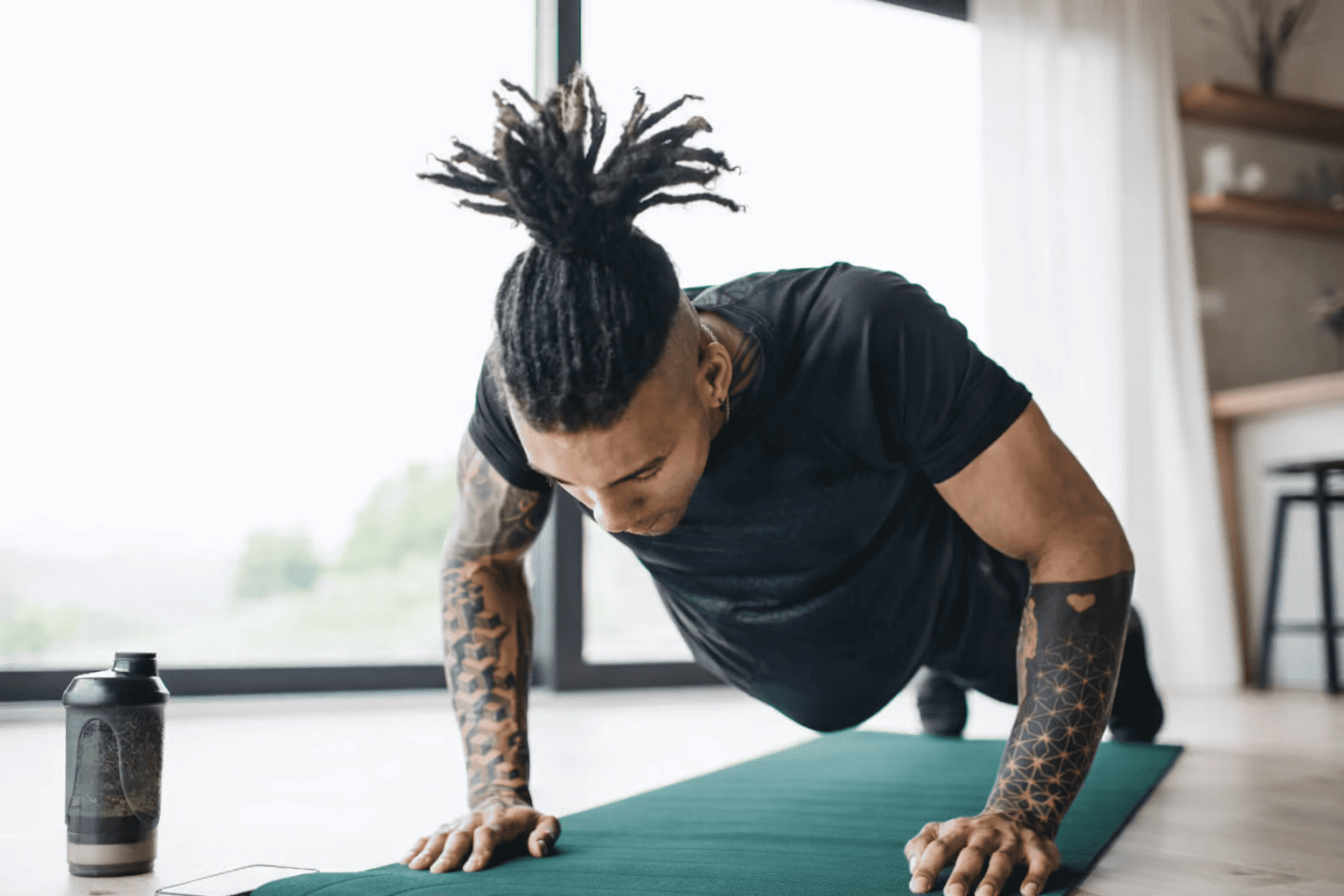

There is a certain kind of curl that has become its own genre of performance. The lifter leans back, the shoulders lurch forward, the hips join the movement as if summoned, and the dumbbells rise on a wave of momentum that the biceps only partly deserve credit for. The set looks heroic. It feels heavy. It is also, very often, a detour.
This is not to say that strict form is a religion, or that a little body English is always a sin. In a long training life, there is room for many styles of effort. But people who want bigger arms tend to make one mistake over and over again: they confuse moving more weight with asking more of the muscle. Those are not the same thing. The research on hypertrophy has become increasingly clear on that point. Lower-load resistance training, when performed with high effort and close enough to failure, can be an effective alternative to traditional heavy lifting for building muscle, even if heavier loads remain more important for maximizing one-rep strength. And newer evidence suggests that training volume still matters: muscle growth tends to improve as weekly direct and indirect set volume rises, though with diminishing returns. In plain English, the body often rewards hard, disciplined work more reliably than theatrical heaviness.
That is especially true for the biceps. Arm training is one of the places where impatience shows up first. People want sleeves to fit differently by next month, so they shorten the range of motion, rush the lowering phase, and let the torso “help” on nearly every rep. The irony is that the biceps are not especially hard to train. They are just easy to interrupt. They respond to tension, consistency and enough weekly work. They also seem to respond to slightly different positions in slightly different ways. A recent randomized trial comparing preacher curls with incline curls found regional differences in elbow-flexor growth: incline curls produced more growth proximally, while preacher curls produced more growth distally. Another 2025 study comparing preacher-style cable curls with Bayesian cable curls found that when resistance profiles were matched, both variations produced similar improvements in biceps and brachialis thickness and strength. The lesson is not that one curl has mystical powers. It is that exercise selection and execution matter, and that the best arm training is often a thoughtful mix rather than a one-exercise obsession.
So if the goal is bigger arms without turning every set into a small act of dishonesty, here are four biceps exercises worth your time. Not because they are trendy, and not because they promise shortcuts, but because they create the kind of tension the arm can actually use.
1. The Incline Dumbbell Curl
The incline dumbbell curl has a way of making strong people feel suddenly candid. Sit them on a bench, tilt the torso back, let the arms hang behind the body, and all the usual shortcuts become harder to hide. The shoulders cannot drift as freely. The torso cannot easily turn the lift into a standing sway. The dumbbells feel lighter than usual, yet the movement feels harder. This is usually a sign that the exercise is doing what it should.
Part of the reason the incline curl works so well is positional honesty. The shoulder is held in extension, which places the long head of the biceps in a lengthened position at the start of each repetition. That tends to make the bottom half of the movement feel demanding in a way standing curls often do not. The appeal here is not only that the exercise is hard to cheat. It is also that longer muscle lengths have become one of the more interesting themes in hypertrophy research. A recent meta-analysis reported that resistance training performed at longer muscle lengths appears more effective for promoting overall, distal and central muscle hypertrophy than training at shorter lengths across several muscle groups. The evidence is still evolving, and it would be foolish to turn one concept into dogma, but the direction is hard to ignore. The incline curl fits neatly into that conversation.
The recent preacher-versus-incline trial adds a useful nuance. Over eight weeks of twice-weekly training, the incline curl produced greater increases in proximal elbow-flexor thickness, while the preacher curl favored distal growth. That does not mean the incline curl is “better” in some absolute sense. It means it seems to bias the stimulus differently. For someone chasing full-looking arms rather than simply chasing numbers on a dumbbell rack, that is useful information. Good bodybuilding has always been less about finding one best exercise than about understanding what each one contributes.
The practical beauty of the incline curl is that it teaches restraint. Most lifters need less weight here than their ego initially proposes. That is good. Choose dumbbells you can control for eight to fifteen repetitions. Let the elbows stay slightly behind the torso rather than drifting forward. Supinate hard as you come up. Lower the weights slowly enough that the bottom position does not become a bounce. A little discomfort in the stretch is normal; losing the shoulder position is not. In a well-run arm session, the incline curl feels less like a stunt and more like a private conversation between the biceps and gravity.
It is also one of the clearest reminders that heavy is not the same as effective. The broader literature on resistance training supports that idea. Lower-load training can build muscle when effort is high, and the muscle does not seem especially sentimental about whether tension comes from a heroic load or a humbler one handled well. The body cares about stimulus, not theater.
2. The Preacher Curl
If the incline curl exposes impatience, the preacher curl exposes momentum.
That is its genius. With the upper arm braced against a pad, the body loses many of the tricks it likes to borrow. The shoulders cannot meaningfully turn the rep into a front raise. The hips cannot turn it into a dance step. The movement gets narrowed down to something more honest: elbow flexion, performed under control, with very little room for fiction. For lifters who say they “feel their biceps more” on preacher curls, this is usually what they mean. The exercise reduces interference.
There is now decent evidence that preacher curls do more than merely feel strict. In the same randomized trial that compared them with incline curls, preacher curls produced greater increases in distal elbow-flexor thickness, while incline curls favored more proximal growth. Strength gains also followed the principle of specificity: people got strongest in the movement they practiced. That is a sensible result and, in its own way, a useful one. It suggests that the preacher curl is not just a beginner-friendly isolation move but a legitimate hypertrophy tool with a somewhat different regional profile than other curl variations.
There is something almost old-fashioned about the preacher curl, and that may be part of why it is easy to underrate. It looks like a classic gym exercise because it is one. But classics last because they solve a problem well. The problem here is that many lifters cannot keep the elbow in the conversation long enough for the biceps to do most of the work. The preacher bench solves that. It narrows the task. It punishes bravado. It makes moderate weight feel sufficient, which is often exactly what good hypertrophy training should do.
That does not mean every preacher curl must be pristine in the style-book sense. Muscles are grown by effort, not by looking decorative. But the exercise rewards lifters who resist the temptation to chase load. The bottom of the movement is where people get impatient, either yanking out of the stretch or cutting the range to stay comfortable. Both choices leave growth on the table. Better to use a weight you can own for ten to fifteen good repetitions, allow a full but controlled descent, and rise without snapping out of the hole.
One underappreciated advantage of the preacher curl is psychological. It makes “strict” feel less like self-denial and more like clarity. The bar path is simple. The setup is stable. A beginner can understand the assignment quickly. An advanced lifter can make the same exercise brutally hard simply by removing momentum and taking the set seriously. And because hypertrophy appears to respond positively to greater weekly volume, a movement that creates targeted fatigue without requiring maximal loads is extremely useful. It lets you accumulate more direct work for the biceps without turning the session into a circus.
3. The Bayesian Cable Curl
The Bayesian cable curl is a more modern entry in the biceps canon, though the principle behind it is old: put the muscle in a stretched position, then make it work hard without letting tension disappear.
If you have not done the movement, the setup is simple enough. Stand facing away from a low cable, take the handle in one hand, and allow the arm to sit slightly behind the body before curling through under control. The result is a cable exercise that feels a bit like an incline curl in spirit, but with the smoother resistance curve that cables tend to offer. Many lifters describe it as one of the first biceps movements that made the entire repetition feel “alive,” not just the middle of it.
The research, interestingly, is more measured than the enthusiasm. A 2025 study compared preacher-style cable curls with Bayesian cable curls in a within-subject design. Young men trained each variation twice a week for ten weeks, with resistance profiles matched between conditions. Both exercises increased muscle thickness across proximal, mid and distal biceps regions, and both improved strength, with no significant differences between conditions. That result is not disappointing. It is clarifying. It suggests that once resistance is sensibly matched, shoulder angle alone may not determine the outcome as much as online arguments imply. The bigger point is that both exercises work.
That matters because lifters often turn exercise selection into ideology. The Bayesian curl is not magic because it is on social media. It is useful because it helps many people keep tension on the elbow flexors without swinging, and because the cable’s line of pull often makes the set feel smooth and continuous. In that sense, it is less a revolution than a convenience. It makes good behavior easier.
There is also a practical virtue to cable work that rarely gets celebrated enough: repeatability. Dumbbells can invite a bit of sloppiness at the top and bottom if the lifter is distracted or chasing weight too quickly. A cable tends to remind you where the job still is. It also allows smaller weight jumps, which makes progression less coarse. For arms, where relatively small differences in load can meaningfully change execution, that matters.
The Bayesian curl shines when done with a kind of quiet patience. Do not lunge forward into the rep. Do not turn it into a standing incline curl performed badly. Set the shoulder, let the arm stay slightly behind the torso, and curl with the elbow rather than the whole upper body. Think of the hand as a hook and the biceps as the driver. The repetition should feel dense, not dramatic.
And because the best available evidence suggests that heavy loading is not required for hypertrophy in the way many lifters imagine, the cable becomes especially valuable for the impatient. It allows the set to feel hard before the weight looks impressive. That is exactly the kind of trade most arm training should make.
4. The Hammer Curl
If the first three exercises are about making the biceps work honestly, the hammer curl is about making the whole elbow-flexor complex more complete.
This matters more than arm-training folklore sometimes admits. “Biceps” is often used as shorthand for the entire front-of-the-arm project, but the upper arm’s look is influenced by more than the biceps brachii alone. The brachialis sits deep to the biceps and serves as a primary elbow flexor. The brachioradialis, meanwhile, contributes from the forearm side of the motion and shapes the arm’s appearance in ways that many lifters notice only after it has been neglected for a long time. In other words, fuller-looking arms are not built only by chasing peak; they are built by training the elbow flexors more completely.
The hammer curl helps because its neutral grip changes the exercise’s muscle synergy. A 2023 study examining different handgrips during curl variations found that hand position meaningfully alters the excitation patterns of the biceps brachii, brachioradialis and anterior deltoid. Supinated grips produced the greatest biceps brachii excitation in that study, but the authors’ broader point was more useful than any one ranking: changing grips changes the stimulus, and practitioners should consider varying handgrips to alter the neural and mechanical demands of the exercise. That is an important reminder for anyone who has been doing only one kind of curl and wondering why arm growth has flattened out.
The hammer curl is sometimes spoken of as a forearm exercise with a biceps cameo, which undersells it. It is better understood as a way to broaden the elbow-flexor stimulus while often being kinder to wrists and elbows than some straight-supinated work. For lifters who get cranky elbows from endless barbell curls, that alone can be reason enough to keep it. For lifters who want thicker-looking arms from the front and side, it provides something their favorite mirror exercise sometimes does not.
The common mistake with hammer curls is exactly the common mistake with all curls: treating them as a test of how much can be swung. Resist that urge. Let the dumbbells hang neutrally. Keep the elbows close enough to the torso that the motion remains a curl rather than a front raise. Raise with intent, lower with control, and let the repetition end when the muscle’s work ends, not when the body finds a more flattering way to continue. Ten to fifteen repetitions usually works well here, though higher-rep sets can be productive too if the tempo stays honest.
What the hammer curl offers, ultimately, is breadth. Not just in the anatomical sense, though that matters, but in the training sense. It reminds the lifter that bigger arms are usually a product of layered training, not singular obsession. A program built only on strict supinated curls may grow the biceps well for a while. A program that also respects the brachialis and brachioradialis tends to age better.
What Actually Builds Big Arms
The larger lesson behind all four exercises is not that strict curls are morally superior. It is that arm growth responds to the same unromantic truths that govern most hypertrophy.
First, effort matters more than ego. The available evidence suggests that a wide spectrum of loads can build muscle, provided sets are performed with sufficiently high effort, typically close to failure. Heavy loads are still useful, especially for strength, and nobody should pretend otherwise. But the biceps are not a muscle group that requires constant maximal loading to grow. In many cases, chasing heavier and heavier curls simply creates more opportunities to move the torso than to challenge the arm.
Second, volume matters. A recent dose-response analysis found that increases in weekly set volume were associated with greater hypertrophy and strength gains, though with diminishing returns. For the practical lifter, that means one heroic curl exercise per week is often less productive than a sensible amount of direct arm work repeated consistently. The body seems to like repeated, recoverable exposure to a good stimulus. That is less romantic than the all-out arm day, but usually more useful.
Third, variation matters when it is purposeful. The incline curl and preacher curl appear to emphasize somewhat different regions of the elbow flexors. Cable-based shoulder-angle variations can both work well when resistance is properly matched. Different handgrips alter the muscular synergy of curl variations. All of that points in the same direction: a good biceps program is not a random collection of exercises, but neither is it monogamous. It uses a few intelligent variations and lets them accumulate work over time.
In practice, that might mean building one arm session around incline curls and hammer curls, and another around preacher curls and Bayesian cable curls. It might mean using controlled sets of eight to fifteen reps for most work, occasionally going a little lower or higher depending on the exercise and the lifter. It almost certainly means keeping the lowering phase more deliberate than your instincts prefer. The biceps are small enough that they notice details and forgiving enough that those details do not need to become neurosis.
There is also a simple point worth keeping in view: sleeve-stretching arms are not built by the curl alone. Back training, rows, chin-up variations, pressing, bodyweight changes, genetics and time all shape how the arm eventually looks. But direct biceps work still matters, and it matters more when it is not diluted by vanity. The best curl is usually the one that lets you keep tension where you intend it, add work over time, and come back next week without needing a shoulder apology.
That, in the end, is what these four exercises do well. The incline curl lengthens and clarifies. The preacher curl removes momentum’s alibi. The Bayesian cable curl smooths the resistance and invites control. The hammer curl gives the arm more total substance. None of them need to be loaded like a deadlift to be productive. They simply need to be done with the kind of discipline people often reserve for more prestigious lifts.
And if structure is the thing that tends to break down before motivation does, that part is easier than many people think. Fitsse describes itself as a workout and nutrition platform that delivers personalized training and meal guidance, with official program pages noting that users can tailor plans by goal, fitness level, available equipment and session length. In practical terms, that means it is easy to have a training program using the Fitsse app instead of inventing your arm work from scratch every week.
Important notice: this content is educational and does not replace an individual evaluation. If you have a history of eating disorders, diabetes, pregnancy, or a medical condition, consult a healthcare professional before making dietary or exercise changes.









 Sign In