


Stress has a way of recruiting your body without asking permission.
It settles into your jaw. It rides your shoulders up toward your ears. It convinces your breath to stay shallow, as if you’re trying not to disturb something in the room. Over time, that low-grade bracing can start to feel like normal — until your back tightens, your sleep gets lighter, and your nervous system forgets what “off” feels like.
Yoga, at its best, isn’t a performance. It’s an intervention: a set of simple shapes and deliberate breaths that remind your body it can soften without collapsing. The goal isn’t to touch your toes or master a handstand. It’s to create enough space — in your ribs, your hips, your spine — that your brain stops reading your body as an emergency.
The poses below are designed for three very common complaints that overlap more than we admit: stress, back discomfort, and trouble sleeping. They’re accessible, mostly floor-based, and meant to be done in a calm, unhurried way. Think less “workout” and more “signal to your system that the day is over.”
A quick note before you begin (especially about back pain)
If you have severe pain, numbness, tingling, radiating symptoms down the leg, or pain that worsens quickly, a professional evaluation is wise. Yoga can help many kinds of back discomfort, but it shouldn’t be used to push through serious symptoms.
For everyone else: move gently. Pain is not the point. Sensation is information.
How to use this article
You can do all 11 poses as a sequence, but you don’t have to. Consider three options:
- 10-minute reset (stress): poses 1, 2, 3, 6, 11
- 15-minute back-friendly flow: poses 2, 4, 5, 7, 8, 10
- 20-minute wind-down for sleep: poses 1, 3, 6, 9, 10, 11
In each pose, aim for 5–10 slow breaths. If you’re new to yoga, hold shorter. If you’re tired, hold longer.
And if you’re the kind of person who wants a rule: exhale longer than you inhale. It’s a reliable way to tell your nervous system you’re safe.
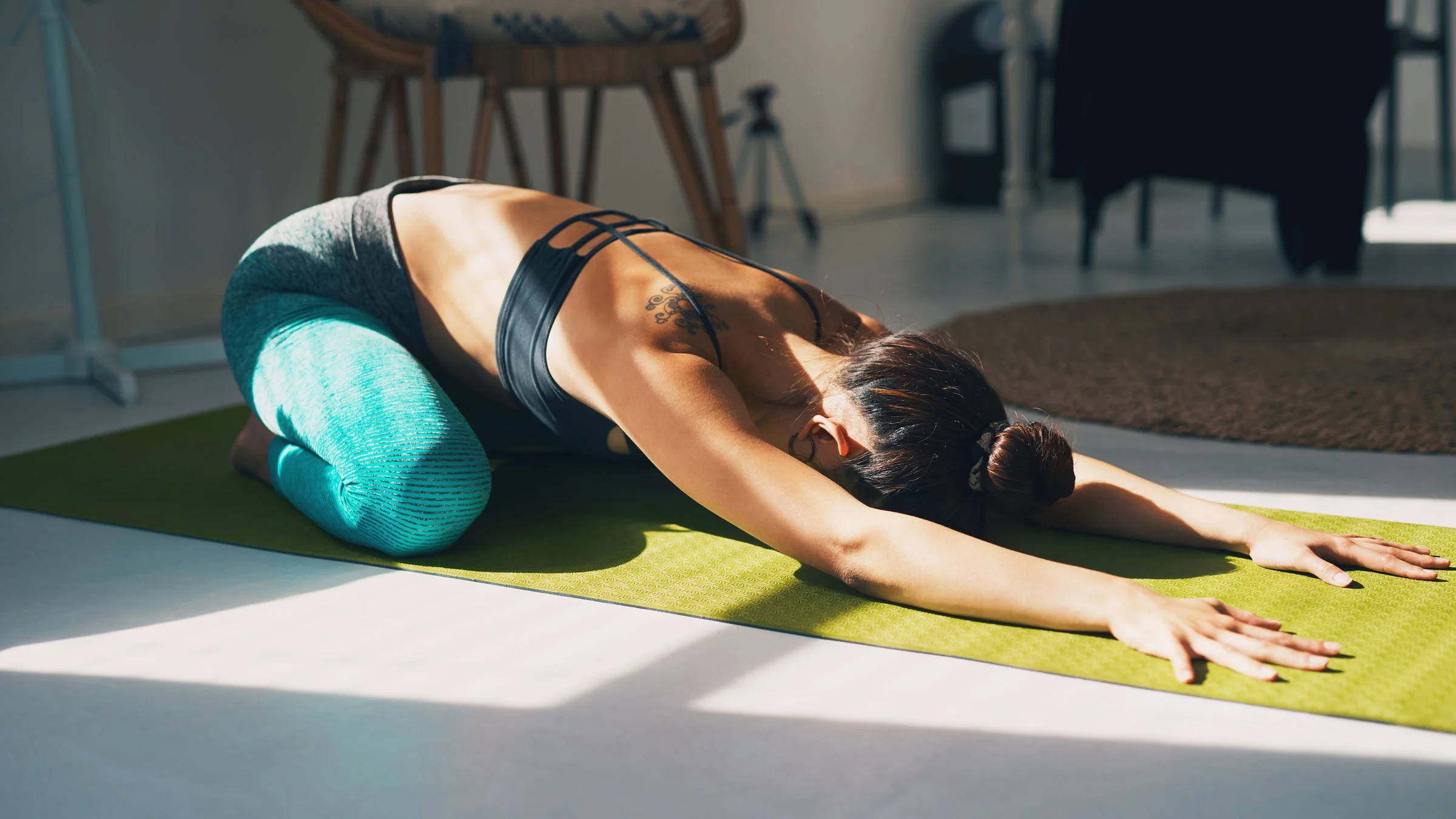
1) Child’s Pose (Balasana)
Best for: stress relief, gentle back decompression
Why it helps: It’s a contained, protective shape that encourages slower breathing and releases tension through the back body.
How to do it:
- Kneel and sit back toward your heels.
- Fold forward, forehead toward the mat.
- Arms can reach forward or rest by your sides.
Make it easier: Place a pillow or folded blanket under your torso or forehead. Widen your knees if your belly or hips feel cramped.
Stay: 8–12 breaths
Tip: Let your belly and ribs expand into the back of your body. This is one of the rare poses where you can literally practice “softening.”
2) Cat-Cow (Marjaryasana–Bitilasana)
Best for: back stiffness, stress-related bracing
Why it helps: It introduces gentle spinal movement — a kind of daily lubrication for the spine — while coordinating breath and motion.
How to do it:
- Start on hands and knees.
- Inhale: lift the chest, tailbone up (Cow).
- Exhale: round the spine, tuck the chin gently (Cat).
Stay: 6–10 slow cycles
Tip: Move as if you’re warming up a stiff hinge. Small is fine. Smooth matters more than dramatic.
3) Legs Up the Wall (Viparita Karani)
Best for: nervous system downshift, sleep prep
Why it helps: It’s restorative and subtly shifts blood and fluid from the legs, while encouraging calm breathing.
How to do it:
- Sit sideways against a wall.
- Swing your legs up as you lie back.
- Let arms rest comfortably.
Make it easier: Place a folded blanket under your hips for gentle support, or bend the knees slightly.
Stay: 2–10 minutes
Tip: If you can only do one pose at night, make it this one. It feels like a “hard reset” for many people.
4) Sphinx Pose (Salamba Bhujangasana)
Best for: gentle back extension, countering hours of sitting
Why it helps: Many backs feel better with a small, supported backbend — not a dramatic one.
How to do it:
- Lie on your belly.
- Prop up on forearms, elbows under shoulders.
- Let chest broaden; keep glutes relaxed.
Stay: 5–8 breaths
Tip: Think “lengthen” more than “bend.” If the low back pinches, lower down or widen the elbows.
5) Thread the Needle (Parsva Balasana variation)
Best for: upper back and shoulder tension, stress neck
Why it helps: Stress often parks itself between the shoulder blades. This twist opens the upper back without forcing the low back.
How to do it:
- Start on hands and knees.
- Slide your right arm under your left, letting right shoulder and side of head rest on the mat.
- Left hand can stay on the floor or reach overhead.
Stay: 6–10 breaths per side
Tip: Breathe into the back of the ribs. You’re not trying to “win” the twist — you’re trying to soften into it.
6) Seated Forward Fold (Paschimottanasana) — Gentle Version
Best for: calming, hamstring and back-body release
Why it helps: Forward folds tend to quiet the nervous system — if you do them in a way that doesn’t provoke strain.
How to do it:
- Sit with legs extended (or knees slightly bent).
- Hinge from hips, keeping a long spine.
- Let hands rest on shins, ankles, or a strap around the feet.
Make it easier: Sit on a folded blanket. Bend the knees more than you think you “should.”
Stay: 8–12 breaths
Tip: If you feel this only as a tug behind the knees, it’s too aggressive. Bend your knees and make it about your breath.
7) Low Lunge (Anjaneyasana) — Hip Flexor Focus
Best for: low back discomfort tied to tight hips
Why it helps: Tight hip flexors can pull on the pelvis, increasing strain in the low back. This pose addresses that, gently.
How to do it:
- From hands and knees, step right foot forward between hands.
- Lower left knee down.
- Lift torso; keep ribs stacked over hips.
Stay: 5–8 breaths per side
Tip: The stretch should be at the front of the hip of the back leg — not in the low back. If you feel your back compressing, soften and tuck the pelvis slightly.
8) Supine Figure Four (Reclined Pigeon)
Best for: glute and piriformis tension, back-friendly hip opening
Why it helps: Many people experience low back discomfort that’s really hip tension in disguise.
How to do it:
- Lie on your back, knees bent.
- Cross right ankle over left thigh.
- Thread hands behind left thigh and gently draw legs toward you.
Stay: 8–12 breaths per side
Tip: Keep head and shoulders relaxed. This is not a crunch.
9) Bridge Pose (Setu Bandhasana) — Supported Option Included
Best for: strengthening the back line, decompressing the front body
Why it helps: A gentle bridge activates glutes and opens the hips. A supported bridge can be deeply calming.
How to do it (active):
- Lie on your back, knees bent, feet hip-width.
- Press feet down and lift hips.
- Keep ribs from flaring; think “long spine.”
Stay: 5 breaths, repeat 2–3 times
Supported version (restorative):
- Place a yoga block or firm pillow under the sacrum (low back area), not under the waist.
- Let hips rest heavily.
Stay: 1–3 minutes
Tip: For sleep, the supported version is often better. Strong isn’t always what your nervous system needs at night.
10) Supine Twist (Supta Matsyendrasana)
Best for: lower back release, end-of-day unwinding
Why it helps: A gentle twist can reduce tension and help reset the spine after sitting and standing all day.
How to do it:
- Lie on your back, knees bent.
- Drop knees to the right, arms out like a T.
- Turn head gently to the left if comfortable.
Stay: 8–12 breaths per side
Tip: Put a pillow under the knees if they hover. Comfort is the assignment.
11) Corpse Pose (Savasana) — The Actual Point
Best for: stress relief, sleep readiness, nervous system “integration”
Why it helps: Savasana is where your body absorbs the message that the effort is over. It’s not “doing nothing.” It’s practicing non-bracing.
How to do it:
- Lie on your back, legs extended, arms relaxed.
- If your low back feels sensitive, place a pillow under your knees.
- Close your eyes or soften your gaze.
Stay: 3–10 minutes
Tip: Try a simple breath count: inhale 4, exhale 6. If your mind wanders (it will), return to the exhale like it’s a handrail.
A simple 20-minute routine for better sleep
If your evenings tend to end with scrolling and a vague sense of being wired, this is a calmer alternative:
- Cat-Cow — 8 cycles
- Thread the Needle — 8 breaths per side
- Supine Figure Four — 10 breaths per side
- Legs Up the Wall — 5 minutes
- Supine Twist — 10 breaths per side
- Savasana — 3 minutes
It’s not flashy. That’s why it works.
How to know you’re doing it “right”
Yoga for stress relief and sleep is successful when it feels almost anticlimactic. You should finish with:
- slower breathing
- less jaw tension
- shoulders that feel heavier
- a back that feels less compressed
- a general sense of “I can stop bracing now”
If you finish feeling more activated — heart racing, breath shallow, mind buzzy — scale down. Use props. Shorten holds. Choose the restorative options.
A few common pitfalls (that are easy to fix)
1) Treating every pose like a stretch contest
Stretching harder is not the goal. Downshifting is.
2) Forcing straight legs in forward folds
Bent knees are not a failure; they’re often the smartest version.
3) Ignoring your breath
If you can’t breathe smoothly, you’re pushing too hard.
4) Doing “night yoga” like it’s cardio
Save strong flows for earlier in the day. At night, your nervous system wants permission to land.
The quiet promise of these poses
The most honest pitch for yoga is not that it will fix everything. It’s that it gives you a way to intervene — a small, repeatable routine that can pull you out of the stress loop before it hardens into your posture and your sleep.
Most days, the fix isn’t dramatic. It’s a softer jaw. A longer exhale. A back that doesn’t feel like it’s carrying an extra person.
And on nights when you can’t sleep, sometimes the best you can do is lie on the floor with your legs up the wall, breathe in a steady rhythm, and let your body remember: you are allowed to rest.
Important notice: this content is educational and does not replace an individual evaluation. If you have a history of eating disorders, diabetes, pregnancy, or a medical condition, consult a healthcare professional before making dietary or exercise changes.









 Sign In