

There’s a particular kind of optimism baked into the dumbbell rack. It’s the idea that you can walk into a gym, pick up two reasonably sized weights, and solve a surprising number of problems: strength, posture, energy, resilience, that vague sense that your body should feel more capable than it does after a day of sitting.
Most fitness promises are loud. Dumbbells are quietly practical.
They don’t require a spotter. They fit in a corner of a bedroom. They’re forgiving enough for beginners and demanding enough for people who have been lifting for years. And in a world where workout plans multiply like browser tabs, dumbbells have a comforting simplicity: move weight well, often, across the major patterns the body needs.
A “whole-body” dumbbell program doesn’t mean doing one exercise that somehow trains everything at once. It means covering the basics: squat, hinge, push, pull, carry, stabilize — with enough balance that you don’t end up with strong arms and a cranky back, or powerful legs and shoulders that feel like they live slightly too far forward.
Below are 11 dumbbell exercises that, together, cover the whole body. Think of them as a toolkit. You don’t have to do all 11 in a single session. Pick a handful, rotate them through the week, and repeat long enough that the movements start to feel like yours — not like choreography you’re memorizing.
A quick note before we begin: effort is normal; sharp pain is not. Move within a range you can control. If you’re new to lifting, start lighter than you think you need. The goal is not to “survive” the workout; the goal is to leave with a body that learns.
1) Goblet Squat
What it covers: legs, glutes, core, posture
Why it matters: If you can squat well, you can do a lot of life well — stand up, sit down, pick things up, get off the floor without making it a project.
How to do it: Hold one dumbbell vertically at your chest, elbows slightly down. Feet about shoulder-width. Sit down and back as if aiming for a chair, then stand up by pushing the floor away. Keep your torso tall and your heels down.
Common fix: If your lower back rounds at the bottom, squat to a box or bench. Depth will come; control comes first.
2) Romanian Deadlift (RDL)
What it covers: hamstrings, glutes, back strength through stability
Why it matters: The hinge pattern is how you lift without turning your spine into the main engine.
How to do it: Hold two dumbbells in front of your thighs. Soften your knees. Push your hips back, sliding the weights down your legs. Feel the stretch in the hamstrings. Stand by driving hips forward.
Common fix: If you feel it mostly in your back, reduce range, keep the weights closer, and slow down.
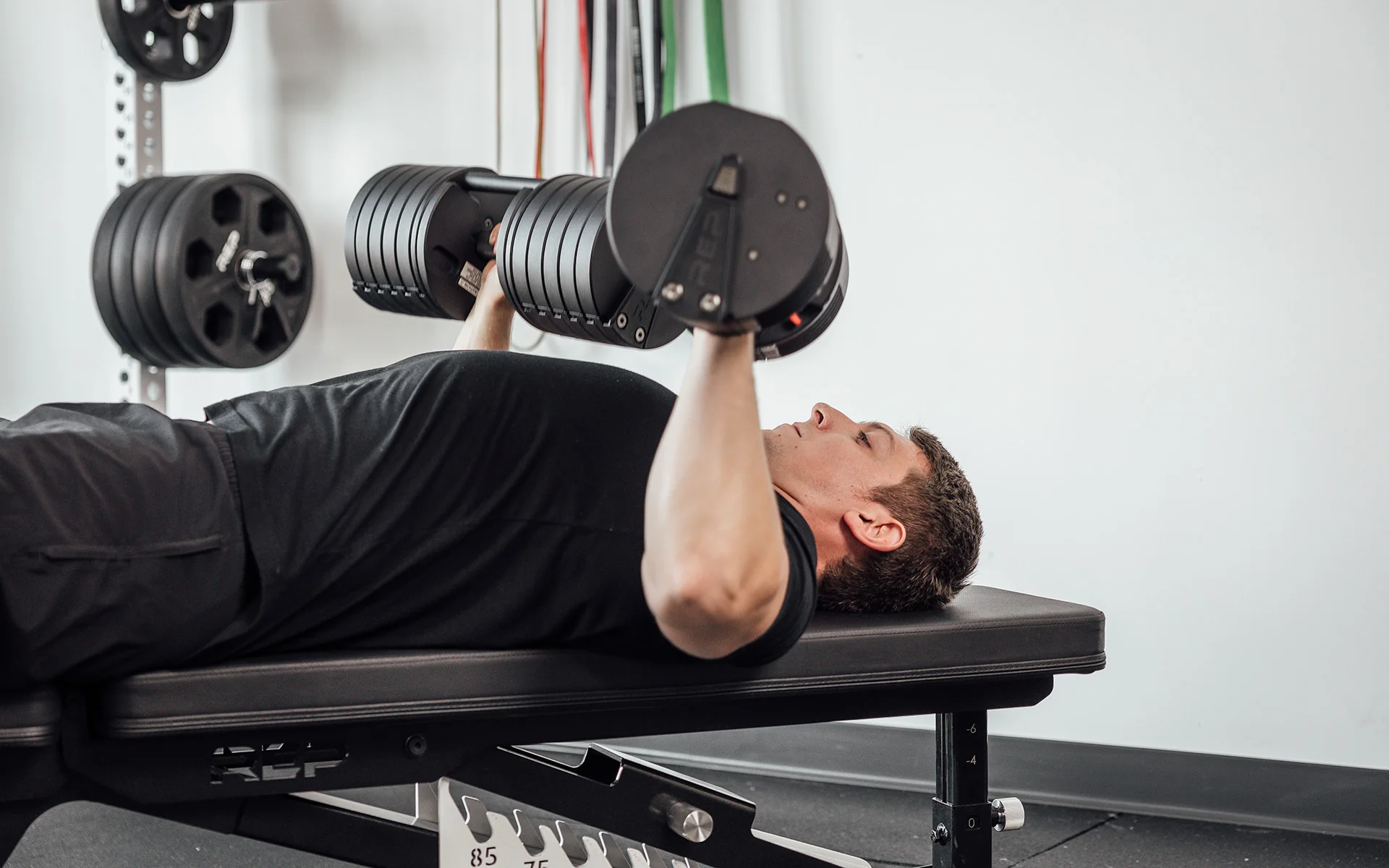
3) Dumbbell Floor Press (or Bench Press)
What it covers: chest, shoulders, triceps, core stability
Why it matters: Pressing strength shows up in doors, strollers, getting up from the floor, and (for many people) improved shoulder confidence.
How to do it (floor): Lie on your back, knees bent. Dumbbells in hands, elbows at about 45 degrees. Press up until arms are straight, lower until upper arms touch the floor.
Why the floor version works: It limits range and can be friendlier to shoulders while still building real strength.
4) One-Arm Dumbbell Row
What it covers: upper back, lats, posture muscles, grip
Why it matters: Most of us push more than we pull — and our shoulders drift forward accordingly. Rows are the antidote.
How to do it: Support one hand on a bench or sturdy surface. Hinge at the hips. Row the dumbbell toward your hip, keeping your shoulder down away from your ear. Lower slowly.
Common fix: If you twist your torso to “help,” use a lighter weight and keep your trunk quiet.
5) Overhead Press
What it covers: shoulders, triceps, core bracing
Why it matters: Overhead tasks are everywhere: luggage, shelves, putting away groceries. Overhead strength is often what people realize they’re missing at the worst moment.
How to do it: Dumbbells at shoulder height. Brace your midsection (ribs stacked over pelvis). Press overhead without leaning back. Lower with control.
Common fix: If you arch hard, try a half-kneeling press (one knee down) to make bracing more natural.
6) Reverse Lunge
What it covers: quads, glutes, single-leg balance, knee-friendly strength
Why it matters: Single-leg strength improves stability for stairs, uneven ground, and the small stumbles you catch without thinking.
How to do it: Hold dumbbells at your sides. Step one foot back, lower into a lunge, then return to standing by pushing through the front foot. Alternate sides.
Why reverse (not forward): Many people find it easier on the knees and more stable than stepping forward.
7) Dumbbell Dead Bug (Loaded Core Stability)
What it covers: deep core, coordination, back-friendly stability
Why it matters: A strong core is less about crunching and more about resisting unwanted movement while your arms and legs do things.
How to do it: Lie on your back, knees and hips at 90 degrees. Hold one dumbbell with both hands above your chest (or two lighter ones). Press low back gently into the floor. Extend one leg while maintaining control, then switch.
Common fix: If your back arches, shorten the leg extension range.
8) Dumbbell Glute Bridge (or Hip Thrust)
What it covers: glutes, hamstrings, pelvis control
Why it matters: Strong glutes help your back feel less “responsible” for everything, and they stabilize hips and knees.
How to do it: Lie on your back, dumbbell across hips (hold it steady). Drive through heels, lift hips, pause at the top, lower slowly.
Common fix: If you feel it in your lower back, reduce range and keep ribs down.
9) Dumbbell Renegade Row (Optional, But Potent)
What it covers: back, arms, core anti-rotation, shoulder stability
Why it matters: This is a two-for-one: pulling plus core control. It also reveals weak links fast.
How to do it: In a strong plank position with hands on dumbbells, feet wide for stability. Row one dumbbell while keeping hips as level as possible. Alternate.
Make it easier: Do it from an incline (hands on a bench) or drop knees to the floor.
Make it harder: Slow it down and pause at the top of each row.
10) Dumbbell Farmer’s Carry
What it covers: grip, core, upper back endurance, “real life” strength
Why it matters: Carries are the most honest strength exercise: you either can hold and move the load, or you can’t. They translate directly to groceries, suitcases, laundry, and day-to-day hauling.
How to do it: Hold heavy dumbbells at your sides. Stand tall. Walk slowly with control for 30–60 seconds (or a set distance). Rest and repeat.
Common fix: If your shoulders creep up, lighten the load and practice “shoulders down, neck long.”
11) Dumbbell Thruster
What it covers: legs, shoulders, conditioning, coordination
Why it matters: Not every workout needs to be metabolic, but having one movement that raises your heart rate while training strength can make a session feel efficient — and honest.
How to do it: Hold dumbbells at shoulder height. Squat down, then stand up powerfully and press overhead in one fluid movement. Bring dumbbells back to shoulders as you descend into the next squat.
Common fix: If form falls apart, separate it: do a squat, stand, then press.
How to Use These Exercises Without Turning It Into a Spreadsheet
The point of a toolkit is not to use every tool at once. Here are a few ways to put this into practice, whether you’re training at home with one pair of dumbbells or in a gym with options.
Option 1: Two Full-Body Sessions a Week (30–45 minutes)
Pick 6 moves:
- Goblet squat — 3 sets of 8–10
- Romanian deadlift — 3 sets of 8–10
- Floor press — 3 sets of 6–12
- One-arm row — 3 sets of 8–12 each side
- Reverse lunge — 2–3 sets of 8–10 each side
- Farmer’s carry — 3 rounds of 30–60 seconds
Add dead bugs or bridges as a short finisher if you have time.
Option 2: Three Short Sessions (20–30 minutes)
Rotate patterns so you stay fresh:
- Day A: Squat + press + carry
- Day B: Hinge + row + core
- Day C: Lunge + bridge + thruster (lighter, faster)
Option 3: The “One Pair of Dumbbells” Plan
If you only have a single weight option, your progression becomes:
- Add reps (within a clean range)
- Slow the tempo (3 seconds down)
- Add pauses (1–2 seconds in the hardest position)
- Add sets
- Move to unilateral versions (one-arm press, single-leg patterns)
Progress is not always heavier. Sometimes it’s simply better.
What “The Right Weight” Feels Like
The correct dumbbell isn’t the one that looks impressive. It’s the one that lets you hold form while working hard.
A good guideline: for most sets, finish with 1–3 reps in reserve. You should feel like you could do a few more if you had to — but you stop because the next reps would get sloppy.
If everything feels easy, you’re not giving your muscles a reason to adapt. If everything feels like a crisis, you won’t recover well enough to be consistent. The sweet spot is effort with control.
Why Dumbbells Work So Well (Especially Now)
They force your body to do what machines often do for you: stabilize. Each arm and leg has to cooperate. Your core has to brace. Your grip has to hold. That’s not a purity test; it’s just useful.
They also make strength training feel less like a performance and more like a practice. You don’t need the perfect setup or the ideal playlist. You need a small set of movements you can repeat and gradually improve.
Because the truth is, most of what people want from fitness isn’t a new body. It’s a more reliable one.
The kind that doesn’t complain when you carry heavy bags. The kind that feels steady on stairs. The kind that can push, pull, lift, and hold — not as a special event, but as a normal part of being alive.
Important notice: this content is educational and does not replace an individual evaluation. If you have a history of eating disorders, diabetes, pregnancy, or a medical condition, consult a healthcare professional before making dietary or exercise changes.





 Sign In